
Reviewed · WWI BATTLEFIELD TOURS
Ypres: An exploration of the deadly salient battlefields
The most powerful part of this Ypres tour is the way it connects enormous wartime events with individual lives. You move from the casualty system and John McCrae at Essex Farm to the cramped remains of Yorkshire Trench, then across the Passchendaele battlefields and into the quiet order of Tyne Cot Cemetery.
I like the small group of no more than seven, which gives you room to ask questions and lets the guide adjust the pace. I also like the clear contrast between Commonwealth and German sites, especially Tyne Cot and Langemark. The main consideration is the subject itself: this is a serious morning of cemeteries, deaths, and wartime suffering, not a light sightseeing trip.
Key points to know before booking
- Seven people maximum: The small van setting makes it easier to hear the guide and discuss family connections.
- Six major stops: You visit Essex Farm, Yorkshire Trench, Langemark, the Brooding Soldier, the Passchendaele area, and Tyne Cot.
- Kim’s personal approach: Kim uses photographs, maps, family stories, and clear explanations to make the battlefields understandable.
- Two sides of the war: Langemark gives you a German perspective alongside the Commonwealth memorials.
- Strong value at $88: For 210 minutes with pickup, drop-off, transport, and guiding, the price is fair.
- Comfortable but moving: You spend much of the time in the van, but comfortable shoes are still important at cemeteries and trench sites.
Why this Ypres battlefield tour works
Ypres is surrounded by places that can be hard to understand on your own. Fields look peaceful now, roads cross old battle zones, and memorials can blur together after a few visits. This tour solves that problem by giving each place a clear role in the story.
The route is not just a string of military monuments. It explains what led to the First World War, how soldiers were recorded as casualties, how the Commonwealth War Graves Commission cared for the dead, and how the area changed after 1918.
That wider frame matters. At Essex Farm, you hear about medical care and individual deaths. At Yorkshire Trench, you get a sense of trench conditions. At Langemark, you consider the German experience. At Tyne Cot, the scale of loss becomes difficult to ignore.
The guide also uses wartime photographs to compare the places you see today with the same locations during the fighting. That is one of the best ways to understand the terrain. Instead of hearing only dates and battle names, you can see how roads, fields, villages, and raised ground affected military decisions.
Kim is the main guide associated with the experience, while Lucas and Roger have also led tours. The strongest praise centers on clear explanations, careful pacing, warmth, and the ability to adapt the presentation to the group. That last point can matter if you have a family connection to a particular regiment, country, or cemetery.
Other Western Front sites within reach of Ypres:
- From IEPER Private 4-hour Tour of the Ypres Battlefield
★ 5.0 · 154 reviews - In Flanders Fields and Passchendaele Half Day Morning Tour
★ 5.0 · 117 reviews - From Brussels: Flanders Fields Remembrance Full-Day Trip
★ 4.4 · 65 reviews
Essex Farm Cemetery and John McCrae
The tour begins at Essex Farm Cemetery, with about an hour at the site. This is a substantial opening stop because it introduces several important ideas at once.
You learn about the casualty system, the work of medical units, and the story connected with John McCrae. The memorial here gives the history a human scale before the tour moves toward larger cemeteries and battlefields.
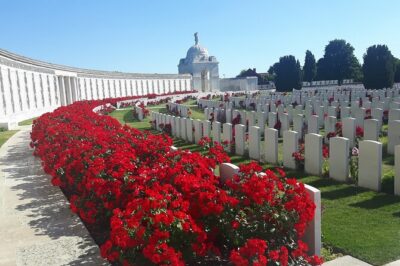
The stop is also useful for understanding how the Commonwealth War Graves Commission approaches remembrance. The cemeteries are carefully maintained, but the presentation is restrained. White headstones, clipped grass, and clear inscriptions leave space for you to focus on the names and dates.
An hour allows the guide to explain the setting without rushing you through it. It also gives you time to look at individual graves and take in the memorial atmosphere. If you have a relative connected with the First World War, tell the guide early. Kim has helped people investigate family members and, when possible, has made small detours to relevant graves or locations.
The only caution is emotional. Essex Farm is not a quick photo stop. You will hear about wounded men, deaths, and the systems built to deal with mass casualties. I would plan this as a quiet start to the day rather than arriving in a hurried sightseeing mood.
Yorkshire Trench and Dug-out: a close look at trench warfare
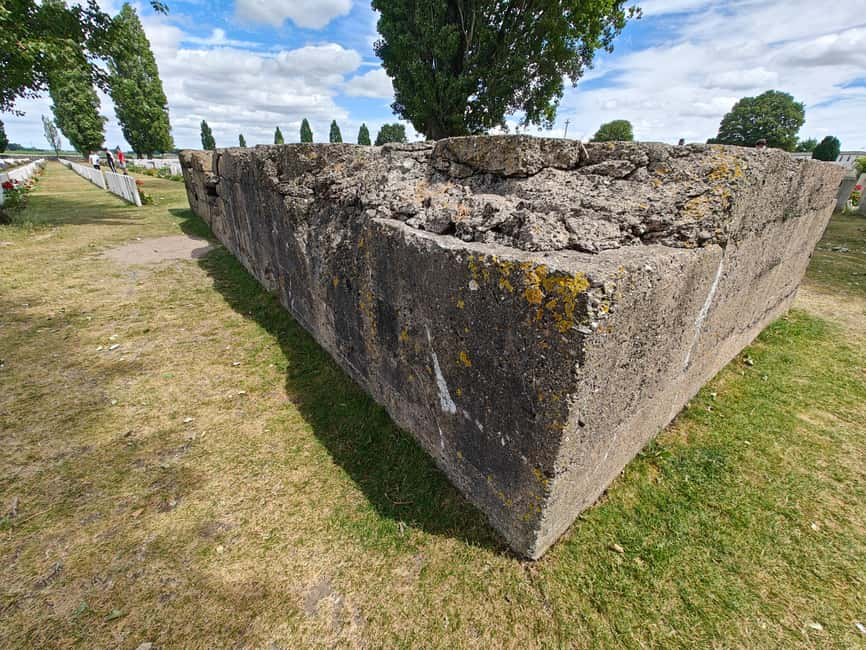
After a short drive, you reach Yorkshire Trench and Dug-out for about 25 minutes. This stop is smaller than Essex Farm, but it changes the mood because you are looking at the physical remains of trench warfare.
The site helps you picture the narrow, practical world soldiers inhabited: dugouts, defensive lines, and confined working spaces rather than open countryside. The value here is not in seeing a perfectly preserved trench system. It is in using what remains, along with the guide’s explanation, to understand how soldiers lived and fought below ground.
Twenty-five minutes is usually enough for a focused explanation and a short look around. The timing also keeps the tour moving toward the larger memorials. You should wear comfortable shoes, since the experience includes walking at outdoor sites and cemetery paths.
This stop may be especially useful if the trench system feels abstract to you in books or museums. Seeing the shape and position of the dug-out gives the rest of the day a physical reference point.
Langemark German Military Cemetery and the other side
Langemark German Military Cemetery receives about 45 minutes. It is one of the most important stops because it prevents the tour from becoming a one-sided account of the war.
The cemetery presents the German dead and the impact of the Great War from a different national perspective. The setting and memorial style differ from the Commonwealth sites, which gives you a useful comparison. You can think about how each country remembered its soldiers, how the dead were gathered, and how the war shaped national memory after it ended.
The guide also places the cemetery within the story of the campaign around Ypres. That context matters because the names of battles can sound detached from ordinary life. At Langemark, the discussion returns to the people affected on both sides.
I appreciate the inclusion of this stop because it adds balance without pretending that every wartime decision was equally defensible. The tour can address the strengths and failures of the campaign while keeping the focus on people and evidence.
Forty-five minutes is long enough for a serious explanation, though anyone hoping to study every inscription may want more time than the group schedule allows. This is a guided visit rather than an open-ended research session.
Same city, a different sort of day:
- From Ypres, The Christmas Truce to Passchendaele Ypres Based WW1 private tour
★ 5.0 · 29 reviews - In Flanders Fields and Passchendaele Grand Tour
★ 5.0 · 25 reviews - From Ypres: WWI Battlefields Private Tour
★ 5.0 · 25 reviews - Full Day Canadian WW1 Vimy and Somme Battlefield Tour from Ypres
★ 5.0 · 6 reviews
The Brooding Soldier at Vancouver Corner
The St Julien Canadian War Memorial, commonly known as the Brooding Soldier, follows after another short drive. The monument commemorates Canadian soldiers and is tied to the fighting around St Julien.
The figure of the soldier gives this stop a different feel from the cemeteries. Instead of rows of individual graves, you encounter a single memorial image and a wider discussion of Canadian service and sacrifice.
This is also the point where the guide can explain how the battlefield looked during the fighting and how the memorial fits into the wider Ypres area. The location helps you connect the military story to the roads and fields you are passing through.
You spend about 25 minutes here. That is enough for a focused account and some time to take in the memorial, but it is not intended as a long independent visit. The short stop works well because the day already includes two major cemeteries and several sites requiring more explanation.
Crossing the Passchendaele battlefields
The drive across the Passchendaele battlefields is one of the tour’s most useful features, even though it is not a single formal attraction. From the van, you see the terrain that shaped the campaign and hear how the fighting affected the area.
Passchendaele is often reduced to a battle name. The drive gives it a physical setting. Roads, fields, villages, and changes in elevation help you understand why movement was difficult and why the fighting became so costly.
This part of the tour also gives your mind a little breathing room between the memorial visits. You remain with the subject, but you are not standing at a grave for every minute of the morning.
The guide may also add a small local stop when time and circumstances allow. One tour included a detour to a chocolatier in the Passchendaele area. That is not presented as a guaranteed feature, so you should treat it as a possible extra rather than a reason to book. Still, it shows the value of having a local guide who knows the area beyond the main monuments.
Tyne Cot Cemetery and the scale of loss
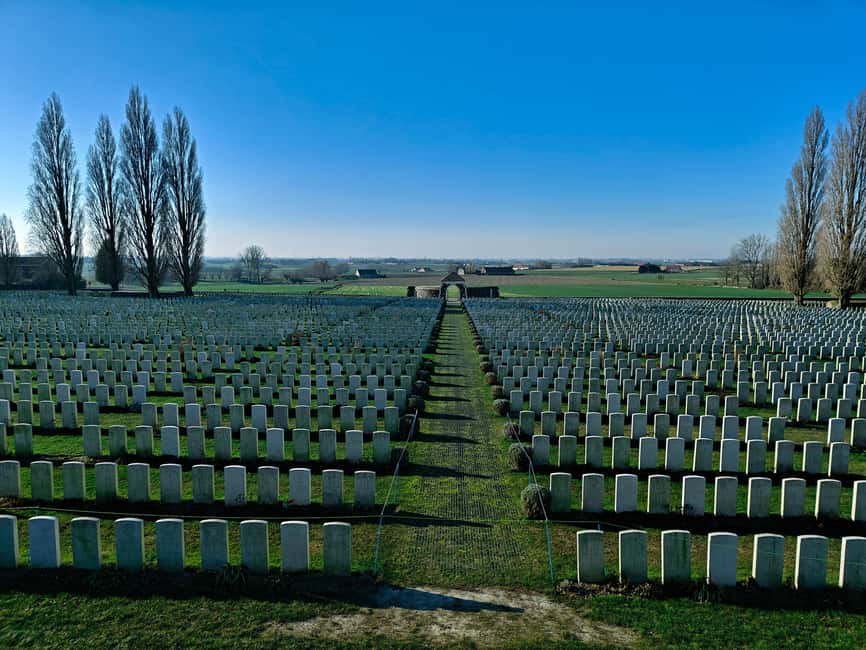
Tyne Cot Cemetery is the final major stop, with about 45 minutes. It is the largest Commonwealth War Graves Commission cemetery in the world, and its size gives the day a sobering finish.
Here the casualty system and the earlier discussion of remembrance come together. You see how a vast number of dead were commemorated in one place, while each headstone still identifies an individual.
Tyne Cot is impressive in scale, but the power of the visit comes from the contrast between the orderly setting and the destruction required to create it. The cemetery is calm and carefully tended. The history behind it is not.
The guide’s role is important here. Without context, you might walk through, take photographs, and leave with only a general sense of sadness. With a clear explanation of the fighting, the memorial work, and the post-war years, the site becomes easier to understand.
Forty-five minutes is a sensible amount of time for a group tour. You can hear the main story, look at the central memorial, and spend a few quiet minutes with the graves. If Tyne Cot is your main reason for coming to Ypres, you may want a separate visit later so you can explore at your own pace.
The guide makes the difference
The most consistently praised part of this experience is the guiding. Kim is described as warm, well prepared, easy to understand, and able to explain difficult subjects without making them dry or theatrical.
That balance is important. A battlefield tour needs facts, but a list of dates will not help you understand what happened. Kim uses maps, photographs, personal stories, and current views of the area to connect the past with what you see from the van.
The tour can also be adjusted to suit the group. People with Australian, Canadian, British, New Zealand, Spanish, or American connections have found ways to relate the route to their own background. Family research has played a role too, with assistance locating relatives and, in one case, a detour to Bard’s Cottage Cemetery.
Lucas and Roger have also received praise for clear and engaging explanations. Since the guide can vary, you should think of the quality as a company strength rather than assuming that Kim will lead every departure.
The tone is generally friendly, but the subject is treated with care. There is room for conversation and occasional humor, yet the tour does not turn the battlefield into entertainment.
Transport, timing, and value at $88
The tour lasts 210 minutes, or three and a half hours, including the drives between sites. Pickup and drop-off are included at an agreed location in Ypres, and transport is provided in a dark blue Mercedes van with the company logo.
A small van is a practical choice here. The sites are spread across the area, and traveling between them by taxi or public transport would be awkward. You also avoid the problem of navigating unfamiliar rural roads while trying to understand the history.
At $88 per person, the value is good if you want several sites in one morning. You are paying for transport, a live English guide, cemetery and battlefield interpretation, and local knowledge. The price is less attractive if you only want to see one or two memorials independently, but that is not what this tour is designed for.
The 7-person limit is another reason the price works. You get a more personal setting than a large coach tour, and the guide can respond to questions or family research interests.
The schedule is full. You should expect regular movement between locations, with the longer stops reserved for Essex Farm, Langemark, and Tyne Cot. Comfortable shoes are listed as essential, and that is sensible even though the van handles most of the distance.
Short-notice bookings may not always be possible, so contact the provider if your plans are close to departure. Cancellation is free up to 24 hours in advance, and you can reserve without paying immediately.
Who should book this experience?
I would recommend it to anyone staying in Ypres who wants a clear introduction to the surrounding battlefields without hiring a car. It is especially useful if you have limited time and want to cover both Commonwealth and German sites.
It suits people interested in military history, family research, memorial design, or the human cost of the First World War. You do not need to be a specialist. The explanations are designed to make the subject understandable, and the guide can adjust the level of detail.
It may be less suitable if you want a leisurely photo tour, extensive time at each cemetery, or a broad sightseeing trip around Flanders. The focus is firmly on the First World War, and the atmosphere is often solemn.
Should you book the Ypres battlefield tour?
Book it if you want the main sites explained in a connected story rather than visited as isolated monuments. The combination of Essex Farm, Yorkshire Trench, Langemark, the Brooding Soldier, Passchendaele, and Tyne Cot gives you a strong view of the area in just 210 minutes.
I especially recommend it for first-time visitors to Ypres, people with military family history, and anyone who wants a balanced presentation that includes German as well as Commonwealth remembrance.
Skip it only if you prefer to explore alone and spend long periods at one cemetery. For most visitors, the small group, local transport, clear guiding, and personal approach make $88 a fair price for a moving and useful morning.
FAQ
Where does the Ypres battlefield tour begin and end?
The tour begins in Ypres and returns to Ypres. Pickup and drop-off are included at an agreed location.
How long does the tour last?
The experience lasts 210 minutes, or three and a half hours.
What sites are included?
The route includes Essex Farm Cemetery, Yorkshire Trench and Dug-out, Langemark German Military Cemetery, the St Julien Canadian War Memorial known as the Brooding Soldier, the Passchendaele battlefields, and Tyne Cot Cemetery.
Is transport included?
Yes. You travel between sites in a minivan, with pickup and drop-off included at an agreed location.
How large is the group?
The tour is limited to seven participants.
What language is the tour conducted in?
The live tour is conducted in English.
Who may guide the tour?
Kimberley Wright is the named experience provider. Kim, Lucas, and Roger have all guided departures.
What should I bring?
Bring comfortable shoes for walking at the cemeteries and outdoor battlefield sites.
Can I cancel or reserve without paying immediately?
You can cancel up to 24 hours in advance for a full refund. Reserve now and pay later is also available.
Just added in Ypres
- From LIlle or Bruges, Christmas Truce to Passchendaele Ypres 1 day WW1 private★ 5.0 · 5 reviews
- From Ypres, The Christmas Truce to Passchendaele Ypres Based WW1 private tour★ 5.0 · 29 reviews
- In Flanders Fields and Passchendaele Grand Tour★ 5.0 · 25 reviews
- Full Day Canadian WW1 Vimy and Somme Battlefield Tour from Ypres★ 5.0 · 6 reviews
- Discover Tournai while playing! Escape game – The alchemist★ 4.0 · 3 reviews
- e-Scavenger hunt Ypres: Explore the city at your own pace★ 4.5 · 6 reviews
- PRIVATE Australian Western Front Battlefields 3-Day Tour Ypres to Amiens★ 5.0 · 3 reviews
- From Ypres 4hr Christmas Truce and Monster Mines of Messines PRIVATE Tour★ 5.0 · 5 reviews
WWI Battlefield Tours, compared.
Great War Flanders Fields Minibus Tour w/ Lunch
Read our review →
Flanders Fields Remembrance Tour from Brussels
Read our review →

In Flanders Fields and Passchendaele Half Day Morning Tour
Read our review →
Remembrance Tour: The Battle of the Bulge in the Ardennes
Read our review →
Historic Battle of the Bulge Sites Tour from Brussels
Read our review →Browse the lists this tour appears in