
Reviewed · HISTORICAL TOURS
Brussels: Art Nouveau Walking Tour with a Local Guide
Brussels reveals its most enchanting side in the streets built around 1900, when architects treated houses as complete works of art. On this three-hour private tour, Eric takes you from the historic center to Etterbeek, Schaerbeek, Ixelles, and St Gilles, explaining the curves, ironwork, glass, mosaics, and odd little details that define Art Nouveau.
I especially like the mix of famous Victor Horta buildings and houses by less celebrated architects. I also like that Eric can adjust the pace and stops to your interests, whether you are new to architecture or already know your Horta from your Hankar. The main consideration is practical: you will walk a lot, use public transport, and pay separately for transport, food, and any attraction entry.
Key points to know
- A private tour with Eric: Expect a personal conversation rather than a fixed, one-size-fits-all group walk.
- Cauchie House and Hôtel Solvay: These major stops anchor the tour with two of Brussels’ finest Art Nouveau names.
- Beyond the famous architects: Square Ambiorix, Ixelles, Etterbeek, Schaerbeek, and St Gilles reveal a broader picture of the movement.
- Public transport is part of the plan: Allow extra time for transfers and bring a ticket or pass, since fares are not included.
- A possible restaurant add-on: You may finish with a meal in a period Art Nouveau restaurant, but food and drinks cost extra.
- Best for curious walkers: Comfortable shoes, weather-ready clothing, water, and a camera will make the outing easier.
Why Brussels is such a good Art Nouveau city
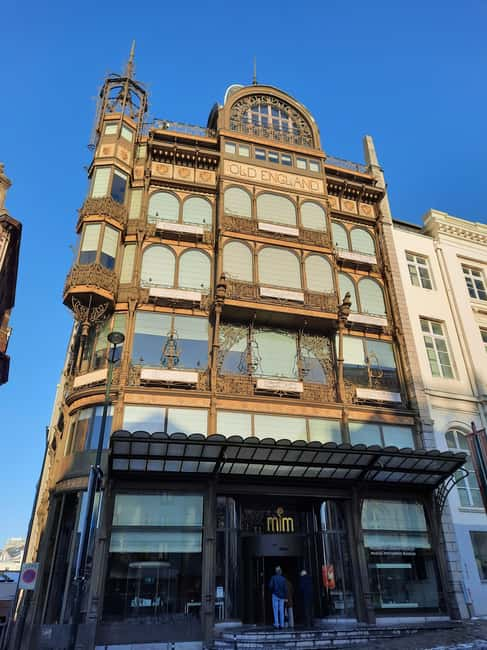
Brussels was one of the key places where Art Nouveau took shape. Around 1900, architects moved away from stiff historic styles and began using plant-like curves, new building materials, flowing floor plans, and carefully designed interiors.
The result is not confined to one museum or grand avenue. It appears on ordinary residential streets, in doorways, on balconies, and in the fine details of houses that still serve as private homes. That makes a walking tour especially useful. You are not simply looking at isolated monuments. You are learning to spot the language of Art Nouveau across several neighborhoods.
I like this tour because it treats the city as a large outdoor collection. The historic center supplies major Brussels landmarks, while the outer districts show where affluent families and architects created experimental homes. You get both the headline names and the less familiar work that gives Brussels its character.
The Belle Époque was brief, and the style later fell out of favor. Some buildings survived unchanged, some were restored, and others still show the marks of more than a century. Eric’s role is to help you read those differences rather than pass every house as if it were equally preserved.
More Historical Tours in Brussels
- Brussels: Historical Walking Tour with Chocolate & Waffle Tasting
★ 5.0 · 1,165 reviews - Brussels: Historical Tour with Chocolate & Waffle Tasting
★ 4.8 · 642 reviews - Evening Tour: The Dark Side of Brussels
★ 4.5 · 435 reviews
Meeting Eric in central Brussels or near Mérode
You have two possible meeting points. The Hilton Brussels Grand Place is used for a route beginning in the historic center and continuing toward Ixelles. The other option is NONA PIZZA near Mérode Metro station, which begins a route through Etterbeek, Brussels, and Ixelles.
That choice matters. If you are staying near the Grand Place or Brussels Central Station, the Hilton meeting point may be simpler. If you are already near Mérode, the second option can put you closer to the neighborhoods covered on that route. Check the exact meeting instructions when booking, since the starting point affects the order of the outing.
The tour is a private group experience, so you are not joining a large crowd. That gives you room to ask questions and lets Eric adjust the conversation. One particularly useful feature is his ability to tailor stops to your interests. You can focus more on architecture, the city itself, the social world of the Belle Époque, or the way different architects borrowed from and changed one another’s ideas.
The guide speaks Dutch, English, French, and Spanish. You should still confirm the language you want when reserving.
Cauchie House, an Art Nouveau calling card
Cauchie House receives a guided visit of about 20 minutes. It is associated with Paul Cauchie, an architect and decorative artist whose home functioned as a kind of personal showcase.
This is a smart early stop because it introduces an important Art Nouveau idea: the building is not just a shell around rooms. The facade, decoration, lettering, and interior details work together. Rather than treating architecture, painting, and craft as separate subjects, Art Nouveau often joined them in one design.
You can expect Eric to point out the features that make the house distinctive and explain how a residence could also serve as an architect’s public statement. The stop is relatively short, so it works as a focused introduction rather than a long museum visit.
Do not assume that every stop is an interior tour. The experience centers on guided viewing of Art Nouveau buildings, and entrance fees to museums or attractions are not included. If seeing interiors is your top priority, ask for clarification before booking.
Square Ambiorix and the northern neighborhoods
After Cauchie House, the route uses public transport for about 10 minutes before reaching Square Ambiorix. The square is one of the more rewarding areas for anyone interested in the city’s residential architecture.
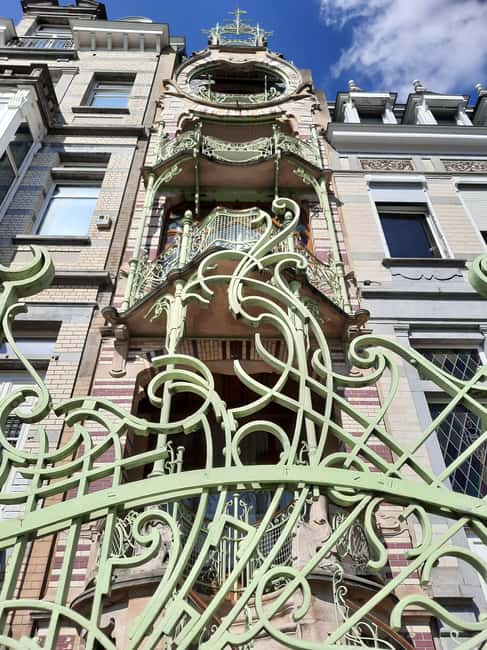
Here the pleasure comes from comparison. Instead of looking at one celebrated facade, you can see how several houses use curves, balconies, stonework, windows, and decorative patterns in different ways. The buildings are close enough to discuss together, which helps you understand that Art Nouveau was not one rigid formula.
The guided time at Square Ambiorix lasts about 40 minutes, making it one of the main teaching sections of the tour. That length gives Eric room to explain the neighborhood and connect the buildings to wider architectural influences. It also gives you time to photograph details without rushing from one facade to the next.
An additional guided stop follows, though its exact location is not specified. That flexibility may be useful on a private tour, since the selection can respond to the day and to your interests. It also means you should not expect a completely fixed list of buildings in every booking.
More Walking Tours in Brussels
- Brussels Chocolate Walking Tour and Workshop
★ 4.5 · 885 reviews - Tell Me About Brussels! | First Day Must-Do | Local Storytellers
★ 5.0 · 649 reviews - Brussels: City Highlights and Hidden Gems Bike Tour
★ 4.8 · 344 reviews - Brussels Tootbus Discovery Hop On Hop Off Bus and walking tours
★ 3.0 · 336 reviews
Public transport between the districts
A second public transport segment lasts about 25 minutes. This is not wasted time, but it does change the rhythm of the experience.
You are moving between neighborhoods rather than spending three continuous hours on foot. That makes it possible to cover more of Brussels and see how Art Nouveau appears in different districts. The tradeoff is that you need to manage your own transport fare, since tickets are not included.
Bring a valid ticket or pass, and allow a little patience for the transfer. The tour information does not specify the exact modes or lines used, so your guide will direct you on the day. If you dislike changing areas during a walking tour, this arrangement may feel less relaxed than a compact central walk. If you want a wider view of Brussels architecture, the transfer is worthwhile.
Ixelles, where the tour opens up
The Ixelles section lasts about an hour, making it the longest single guided portion. That extra time lets the tour move beyond quick facade-spotting and look at the district as a whole.
Ixelles is one of the city’s important Art Nouveau areas, and the tour uses it to show how residential streets became laboratories for new design. You may see houses that remain close to their original appearance, buildings that have been carefully renovated, and others whose age is part of their appeal.
This is also where Eric’s local knowledge matters most. The supplied route covers several districts, but the point is not simply to count buildings. It is to understand why a particular doorway, window, or facade matters, and how a lesser-known architect can be just as inventive as a famous one.
I would give this section your full attention. The quick pleasure of a beautiful facade is easy to get. The more lasting reward is learning what to look for when you continue exploring Brussels alone. After this tour, you may notice Art Nouveau details on buildings that you would previously have walked past.
Hôtel Solvay and Victor Horta’s grand vision
The tour includes about 20 minutes at Hôtel Solvay, one of Victor Horta’s major creations. Horta is the name most closely associated with Brussels Art Nouveau, and this stop gives you a chance to see why.
Horta’s work is often praised for its flowing lines, but the real point is the relationship between structure and decoration. Staircases, light, materials, furniture, and ornament were planned as parts of one whole. At Hôtel Solvay, the building represents the ambitions of a wealthy client and the confidence of an architect working at the height of the Belle Époque.
The stop is brief compared with the Ixelles walk, so think of it as a concentrated look rather than a full architectural study. Ask Eric questions while you are there. The private format is most valuable when you use it to compare Horta with the other architects encountered earlier.
As with Cauchie House, confirm what portion of the building you will enter or view. The activity includes a guided Art Nouveau tour, but it does not include museum or attraction entrance fees.
What makes a private guide useful here
Art Nouveau can look obvious at first: curved lines, decorative facades, and elaborate doors. A good guide takes you past the first impression.
Eric brings a broad grasp of architecture and its overlapping influences. He can speak to the connections between styles and places, then adjust the level for your group. That matters if one person in your party is an architecture enthusiast and another is simply drawn to beautiful buildings.
His tone is described as friendly, humorous, and welcoming, with enough depth for serious students but an accessible pace for non-specialists. You do not need to arrive with a book of architectural terms. You can ask basic questions without feeling out of place, and you can push further if you already know the subject.
The personal format also helps with pacing. Some people want time for photographs. Others want to keep moving and hear more context. A private guide can respond to that better than a large scheduled group.
Food in an Art Nouveau setting
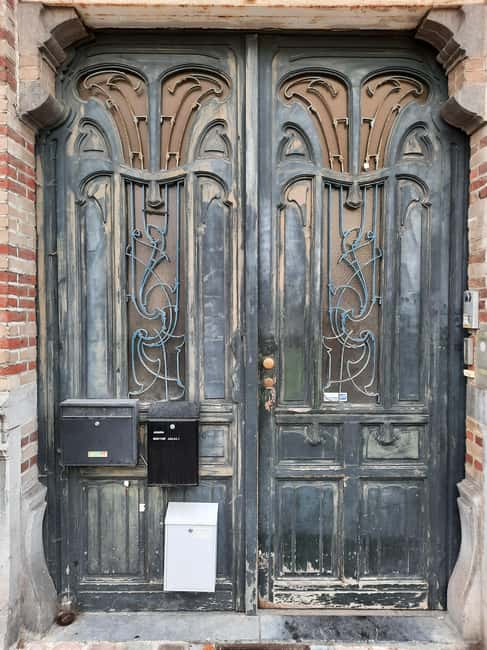
If you want to extend the experience, the walk can include a meal at a period Art Nouveau restaurant. The decor is described as surprising and moving, with much of its character preserved for more than a century.
This is an appealing option if you care about interiors as much as facades. Art Nouveau was never only an exterior style. A period restaurant can show how the movement shaped dining rooms, decoration, atmosphere, and everyday public life.
The meal is optional and not included in the $91 price. Food and drinks are also separate, so treat this as an add-on rather than part of the base tour. Ask ahead about the restaurant plan, timing, and cost if you want the meal included.
Is $91 a fair price?
At $91 per person, this is not a bargain-priced orientation walk. The value comes from the private format, the three-hour duration, the range of neighborhoods, and Eric’s ability to tailor the route.
You are paying for more than a list of facades. The tour combines the historic center with Etterbeek, Schaerbeek, Ixelles, and St Gilles, and it uses public transport to connect areas that would be difficult to cover efficiently in one short walk. The guide’s expertise is especially useful in Brussels, where important Art Nouveau buildings are spread across the city.
The price makes the most sense for a small private group that wants a focused architectural experience. If you are mainly looking for a quick introduction to Brussels, a shorter central walk may be enough. If Art Nouveau is one of your reasons for visiting Brussels, three hours with a specialist can provide better value than trying to find and interpret the buildings alone.
The experience currently has a five-star rating from five submitted evaluations, and the strongest praise centers on Eric’s passion, flexibility, personal attention, and ability to make a large city feel more manageable. That is the part of the price I would weigh most heavily.
Practical advice before you go
Wear comfortable shoes. The tour involves walking through several neighborhoods, and Brussels streets are not uniformly easy underfoot.
Dress for the forecast and carry water. You will be outdoors for much of the experience, even though some stops may involve interiors or shorter visits. A camera is useful, since the architectural details are often smaller than the full facade.
Plan for transport costs. Public transport tickets are not included, and the route has two transfer periods of roughly 10 and 25 minutes. Keep your ticket or pass ready so the group is not delayed.
The activity is not well suited to wheelchair users. The information provided openly notes that Brussels streets are not very adapted to wheelchairs, so ask specific accessibility questions before reserving. Smoking indoors, smoking in the vehicle, alcohol, drugs, weapons, sharp objects, littering, and party groups are not allowed.
Free cancellation is available up to 24 hours before the start, and you can reserve while paying later. Those policies are helpful if your Brussels plans are still shifting, but check the current booking terms for your chosen date.
Who should book this tour?
I would choose this tour if you want architecture explained in plain language, prefer a private group, and like seeing how a city changes from district to district. It is a strong fit for couples, families, and small groups with mixed levels of interest because Eric can adjust the depth and pace.
It also suits repeat visitors who have already seen the Grand Place and want a different side of Brussels. The route reaches neighborhoods many people skip, while still including major names such as Horta.
I would think twice if you want a completely flat, uninterrupted walk, guaranteed museum entry, or a fixed schedule with every building named in advance. Transport, meals, and attraction fees are extra, and the tour requires a reasonable level of walking.
For most architecture fans, though, the combination is persuasive: a local guide, a private setting, famous Horta buildings, less familiar work, and enough time to understand what you are seeing. You should book it if you want Brussels to become more than a collection of pretty facades.
FAQ
How long does the Brussels Art Nouveau tour last?
The tour lasts three hours. Check availability for the starting times offered on your chosen date.
Where does the tour begin?
There are two possible meeting points: Hilton Brussels Grand Place or NONA PIZZA near Mérode Metro station. The Hilton meeting point begins a route through the historic center and Ixelles, while the Mérode meeting point begins a route through Etterbeek, Brussels, and Ixelles.
Which languages are available?
The live guide can conduct the tour in Dutch, English, French, or Spanish.
Are public transport tickets included?
No. The route includes public transport between districts, but you must pay for your own transport tickets.
Is the Art Nouveau restaurant meal included?
No. A meal at a period Art Nouveau restaurant can be included as an optional part of the walk, but meals and drinks are not included in the price.
Is this tour suitable for wheelchair users?
The tour information warns that Brussels streets are not well adapted to wheelchairs. Contact the provider before booking to discuss your specific needs.
More of the past around Brussels
- Brussels 3-Hour Guided Art Nouveau Tour
★ 4.0 · 282 reviews - Historical Walking Tour: The Story of Brussels – by Legends
★ 5.0 · 164 reviews - Brussels: Art Nouveau Pass – Entry to Three Locations
★ 4.0 · 108 reviews - Brussels: Museum Art & History Entry Ticket
★ 4.5 · 58 reviews
More guided walks around Brussels
- Brussels: Walking Tour with Belgian Lunch, Chocolate, & Beer
★ 4.7 · 300 reviews - Brussels Highlights & Hidden Gems Private Tour with a Local Guide
★ 5.0 · 251 reviews - Brussels: Chocolate Workshop and Guided Walking Tour
★ 4.7 · 225 reviews - Brussels Highlights & Hidden Gems Bike Tour
★ 5.0 · 195 reviews
Just added in Brussels
- Standard vehicle from Brussels airport to city of Antwerp★ 5.0 · 4 reviews
- Luxury vehicle from Brussels airport to the city of Brussels★ 4.0 · 5 reviews
- Transfer Brussels Airport (BRU) –> City Center 7 PAX (ONE WAY)★ 5.0 · 7 reviews
- PRIVATE MPV TRANSFER FROM/TO BRUSSELS AIRPORT (Max 6 pax) ONE-WAY★ 5.0 · 4 reviews
- Luxury Minivan from Brussels airport to the city of Brussels★ 4.0 · 7 reviews
- Transfer Brussels Airport –> Brussels MB V Class 7 PAX (ONE WAY)★ 5.0 · 4 reviews
- Transfer Brussels Airport –> City MB E Class 1-3 PAX (ONE WAY)★ 5.0 · 6 reviews
- Brussels: City Walk with Audioguide in 7 Languages on your Phone★ 3.5 · 4 reviews
Historical Tours, compared.
Historical Walking Tour with Chocolate & Waffle Tasting
Read our review →
THE Storytelling Tour of Bruges | First Day Must | History & Tips
Read our review →
Browse the lists this tour appears in