
Reviewed · HISTORICAL TOURS
Brussels: 2-hours “Art Nouveau” Walking Tour
Brussels is one of the best places in Europe to see Art Nouveau in its original setting, and this tour gets you beyond the usual postcard sights. You’ll trace the movement from its early ideas to celebrated buildings such as Horta’s Hôtel Tassel, Maison Cauchie, Maison Saint Cyr, and the Hôtel van Eetvelde. I like the way the tour connects decorative details to the wider story of modern architecture, and I like that a private English-speaking guide can adjust the explanation to your interests.
The main caution is that the experience is advertised as a walking tour, yet the buildings are spread across several Brussels neighborhoods. One recent participant was driven by car, while another praised guide Yves for taking the group farther than expected in his car. Confirm the transport plan and meeting point before you set off, especially since one booking had a confusing meeting-location problem.
Key points to know before booking
- You begin at Mérode, in front of Brasserie Carpe Diem near the Mérode Metro Station entrance.
- The route covers many separate buildings, including work by Victor Horta, Paul Hankar, Gustave Strauven, and other Brussels architects.
- The advertised route is on foot, but a car may be used because the sights stretch from the Cinquantenaire area toward Saint-Gilles.
- The tour is private and in English, giving you more room to ask questions than on a large group outing.
- Guides named in recent feedback include Yves, Davit or David, and Eric, with the strongest praise focused on passion and clear explanations.
- The tour does not include interior admission, and the program can change according to availability.
Why Brussels is the right place for an Art Nouveau tour
Art Nouveau was not just a way to decorate a doorway. In Brussels, it changed the way architects thought about private homes, townhouses, ironwork, stained glass, furniture, and the relationship between a building and the street.
That makes a guided tour useful. If you walk alone, you can admire a curling balcony or a mosaic entrance without knowing why it matters. A good guide points out the flowing plant forms, curved lines, unusual materials, and careful unity between the façade and the interior design.
The tour begins with an explanation of how Art Nouveau emerged and why it seemed so modern at the time. You’ll also hear about different Art Nouveau trends. That matters because Brussels does not offer one neat, uniform style. Some houses are graceful and organic. Others are more geometric, theatrical, or heavily decorated.
I like this opening lesson because it gives you a visual checklist for the rest of the route. Instead of simply collecting façades, you begin to compare them.
More Historical Tours in Brussels
- Brussels: Historical Walking Tour with Chocolate & Waffle Tasting
★ 5.0 · 1,165 reviews - Brussels: Historical Tour with Chocolate & Waffle Tasting
★ 4.8 · 642 reviews - Evening Tour: The Dark Side of Brussels
★ 4.5 · 435 reviews
Starting at Mérode and the Cinquantenaire
The meeting point is in front of Brasserie Carpe Diem, opposite the Mérode Metro Station. The station has three exits, so use the location image supplied with your booking and allow extra time to identify the correct one.
The tour then begins around the Parc du Cinquantenaire, where you receive roughly 15 minutes of guided introduction. This is a sensible starting area because it gives you a broad setting before the focus shifts to individual houses.
You should treat this first section as orientation rather than a major sightseeing stop. The value lies in understanding the movement before the route becomes a rapid sequence of façades. If your guide sets out the main visual clues clearly, the later buildings become easier to read.
One practical point is worth stressing: this is listed as a two-hour experience, not a leisurely half-day architectural walk. You will cover a lot of ground and see many addresses. Expect focused explanations and exterior viewing rather than long visits inside every building.
Maison Cauchie and the art of the façade
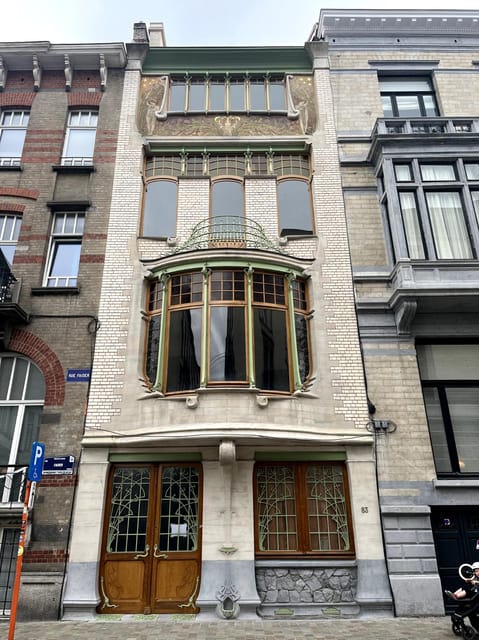
Maison Cauchie is one of the names that makes this route appealing. The house is known for the way its exterior decoration forms part of the architecture rather than sitting on top as an afterthought.
Here, pay attention to the front elevation as a complete composition. Art Nouveau often treated the façade as a canvas, combining lettering, line, figures, floral motifs, and architectural structure. Your guide can help you see how those parts work together.
For you, the important question is not simply whether the house is pretty. Ask how it announces the taste and identity of the owner. In Brussels, a private townhouse could function as a public statement, showing that its resident was interested in new ideas, new design, and a break from old architectural rules.
The tour’s value rises when the guide explains those connections instead of merely naming the building. Maeve described the houses as difficult to locate without a guide, and that is a useful warning. Many of these addresses are scattered through residential streets, where you could easily walk past them without realizing what you had missed.
Palais Stoclet and the range of Brussels design
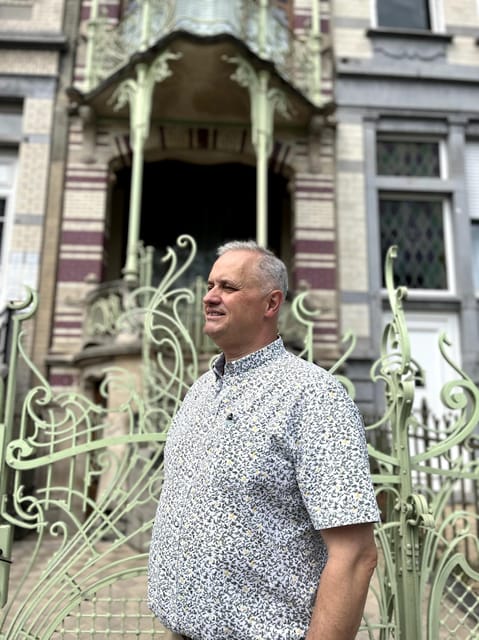
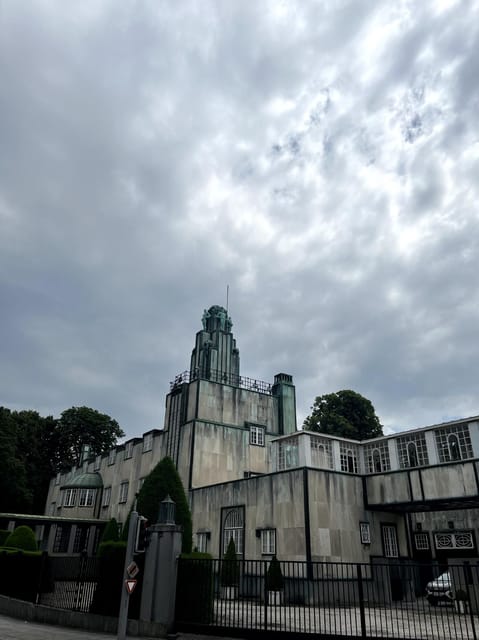
The Palais Stoclet appears among the principal stops, although the program can change. Its inclusion helps show that Brussels Art Nouveau was not limited to the flowing, plant-like forms most people expect.
The building is useful for comparing different approaches to the movement. Art Nouveau could be soft and curving, but it could also move toward stronger geometry and a more controlled design. This contrast is one reason the tour’s introduction to different trends matters.
You may not spend a long time at each address. That is the trade-off of trying to cover so many buildings in two hours. Still, a short explanation can be enough if you already have a basic interest in architecture and want a guided overview of the city’s major examples.
If you prefer to study one building in depth, a dedicated museum visit may suit you better. This tour is designed to connect many buildings across Brussels, not to give you a long interior visit at one location.
More Walking Tours in Brussels
- Brussels Chocolate Walking Tour and Workshop
★ 4.5 · 885 reviews - Tell Me About Brussels! | First Day Must-Do | Local Storytellers
★ 5.0 · 649 reviews - Brussels: City Highlights and Hidden Gems Bike Tour
★ 4.8 · 344 reviews - Brussels Tootbus Discovery Hop On Hop Off Bus and walking tours
★ 3.0 · 336 reviews
Maison Saint Cyr and the more theatrical side of Art Nouveau
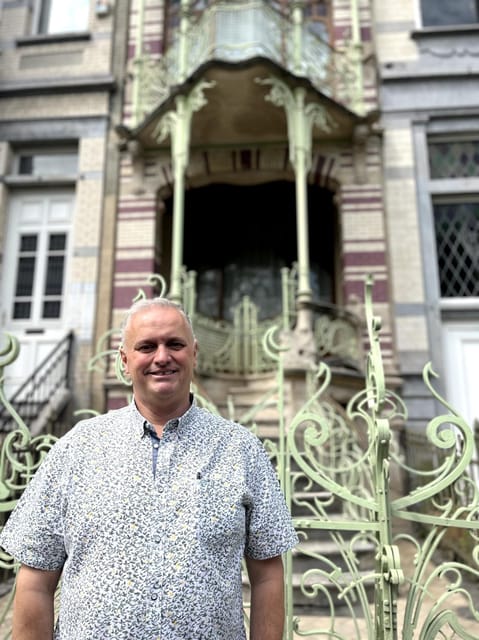
Maison Saint Cyr is another important stop. Its design is often associated with a more exuberant and tightly packed form of Art Nouveau, with decorative details competing for your attention.
This is the sort of building that rewards a slow look, even if the overall tour moves at a steady pace. Look upward, then work down the façade. Notice the balconies, windows, ironwork, and the way the lines appear to pull the building into motion.
A guide is especially helpful here because the exterior can feel visually busy. You might find it hard to decide where to look first. A clear explanation gives order to the decoration and shows how the house differs from Horta’s more restrained compositions.
That comparison is central to the experience. The tour is not only a greatest-hits parade of famous addresses. At its best, it teaches you that Art Nouveau was a broad movement with several personalities.
Horta’s houses, from Hôtel van Eetvelde to Hôtel Tassel
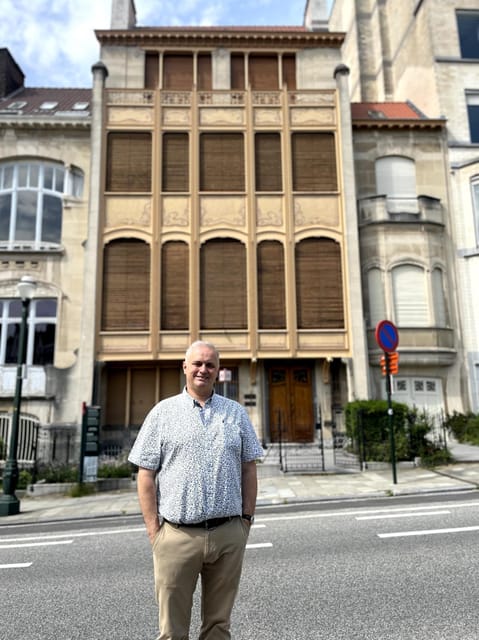
Victor Horta is the name most closely linked with Brussels Art Nouveau, and the route includes several of his major works. These include Hôtel van Eetvelde, Hôtel Tassel, Maison et Atelier Horta, and the house associated with Horta’s brother.
Hôtel Tassel is particularly important because it is one of the buildings most often connected with the birth of Brussels Art Nouveau. At the exterior, look for the way the architecture avoids a rigid separation between structure and decoration. Curving lines, metalwork, glass, and stone are meant to belong to one design.
Hôtel van Eetvelde gives you another chance to see Horta’s approach in a different setting. The tour can help you compare the treatment of the entrance, windows, and decorative details across his work.
The Maison et Atelier Horta is also a valuable stop because it connects the architect’s professional life with his design ideals. It is one thing to see Horta’s work spread through the city. It is another to see a building associated with the place where he lived and worked.
You should not assume that every interior is included. The information provided describes a guided tour of buildings, but it does not promise interior entry. If seeing Horta interiors is your main goal, treat this walk as a citywide introduction and arrange a separate museum visit if needed.
One participant said the tour made a visit to the Horta Museum more valuable. That is exactly how I would use this experience: let the route give you context, then spend more time inside one dedicated museum or house afterward.
Maison Van Dyck, Maison Roosenboom, and the smaller addresses
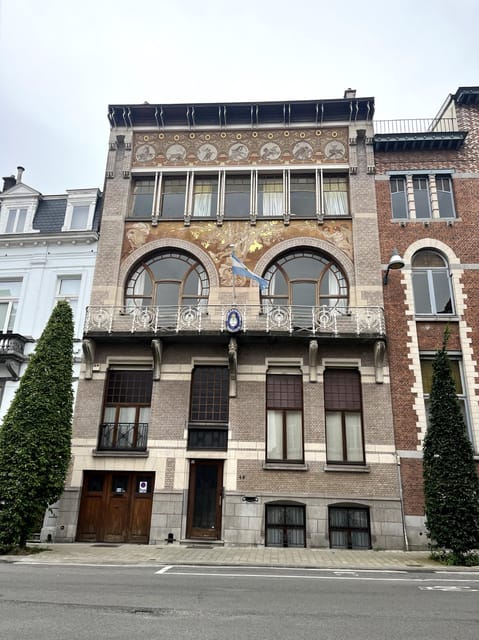
The route also includes Maison Van Dyck and Maison Roosenboom. These less universally known names are part of the reason to hire a guide rather than rely only on a standard city walk.
The big landmarks are easy to find in guidebooks. The smaller houses require more local knowledge, and their significance can be hard to judge from the pavement. You need someone to point out what makes the design worth your attention.
Maison Roosenboom, for example, fits into the wider story of domestic Art Nouveau. It gives you a chance to see how the movement appeared in private residential architecture, not only in grand public projects.
You may find that these stops are quick. That is not necessarily a flaw. A short exterior visit can work well when the guide explains the key feature and then lets you take a photograph before moving on.
The route also names Hôtel Ciamberlani, Maison Hankar, and Maison Hannon. These stops widen the picture and help you compare architects, clients, and decorative styles. Since the schedule and availability can change, do not treat the published list as a guaranteed order.
The route from central Brussels toward Saint-Gilles
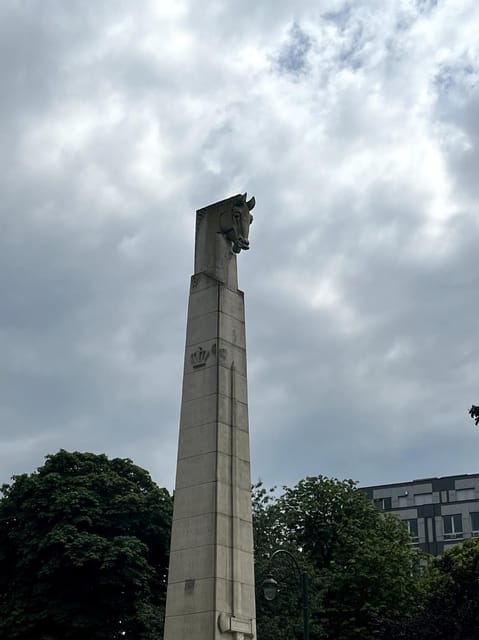
The final point is on Avenue de la Jonction in Saint-Gilles. The route therefore moves across more than one part of Brussels rather than staying around the Cinquantenaire.
This geography explains the possible use of a car. A two-hour walk covering every named address would be demanding, and the tour description does not provide a full walking distance. One participant specifically objected that the experience became a drive rather than the promised walk, while another appreciated being driven to more sites.
That difference matters. If you want exercise and street-level wandering, tell the operator that the walking format is important to you. If you mainly want to see a large number of Art Nouveau buildings within a short time, vehicle transport may be useful.
Do not assume public transport is included. Transport tickets are not part of the price, and the tour may use a car under circumstances that are not fully explained in advance. Clarify the plan before the day of the tour.
What the guides add to the experience
The strongest part of the feedback concerns the guides. Davit, also referred to as David in one account, was praised for being informed and articulate. Eric was credited with making the subject absorbing, and Yves was willing to drive the group farther so they could see more.
You should still keep your expectations measured. One recent participant found the guide pleasant but felt the architectural explanations were weak. That mixed result suggests that the guide makes a major difference here.
This is a private-group experience, so use the format to your advantage. Ask why one façade feels more geometric than another. Ask which elements are original, which architects worked in the same period, and what separates the different Brussels trends.
The best guides on this subject do not simply recite names and dates. They show you how to look. A passionate guide can turn a two-hour outing into a useful foundation for the rest of your time in Brussels.
Is $136 a fair price for two hours?
At $136 per person, this is not a cheap orientation walk. The price makes sense only if you value a private guide, a citywide route, and access to buildings that are difficult to locate on your own.
It is less attractive if you want a basic stroll through one neighborhood. You could spend two hours seeing fewer buildings at a lower cost, especially if you are comfortable using a guidebook and public transport.
The value improves for first-time Art Nouveau visitors who want help making sense of the city. The route includes many significant names, and the buildings are spread across several areas. You are paying for selection, explanation, and navigation, not just for time on the pavement.
Because the advertised format and actual transport may differ, ask exactly what the $136 covers. Confirm whether the guide will walk the full route or use a car, and ask whether any interior entry is planned.
Who should book this Brussels Art Nouveau tour?
I would recommend it most strongly to you if:
- You have a real interest in architecture, design, or decorative arts.
- You want to see more than one famous Horta building.
- You would struggle to find residential Art Nouveau houses on your own.
- You prefer a private English-speaking guide.
- You want an introduction before visiting the Horta Museum.
- You are comfortable with a fast route and possible vehicle transport.
I would be more cautious if you need a fully confirmed walking route, want wheelchair access, or expect a long interior visit. The experience is not suitable for wheelchair users, and smoking is not allowed.
You should also leave room in your schedule for the meeting point. Mérode has three exits, and one booking suffered from incorrect meeting information. Bring the exact location details and do not rely on a quick glance at the station signs.
Should you book it?
Book this tour if you want a focused introduction to Brussels Art Nouveau and appreciate having someone explain why each house matters. The range is impressive for two hours, and the route can make a later Horta Museum visit much more meaningful.
Before paying, confirm the meeting point, the guide, and the transport plan. That small check is important because the experience has received both strong praise for passionate guides and a serious complaint about the wrong meeting location and an unexpected car-based route.
With those expectations clear, this can be a very useful architectural outing. You will see houses you might never find alone, learn how to distinguish Brussels Art Nouveau styles, and leave with a better eye for the details scattered across the city.
FAQ
Where does the Art Nouveau tour meet?
Meet in front of Brasserie Carpe Diem, opposite the Mérode Metro Station entrance. Mérode has three exits, so use the location photo supplied with the booking to identify the correct meeting point.
How long does the tour last?
The tour lasts two hours. The itinerary includes about 15 minutes around the Cinquantenaire and roughly 1.5 hours visiting Art Nouveau buildings, with additional time connected to the final stop.
Is the tour conducted in English?
Yes. The tour has a live English-speaking guide.
Is this a private tour?
Yes. The group type is private.
Is transport included?
Transport tickets are not included. The experience is described as a walking tour, but the buildings are spread across Brussels and a car may be used. Confirm the transport arrangement before the tour.
Is the tour suitable for wheelchair users?
No. The activity is listed as unsuitable for wheelchair users.
More of the past around Brussels
- Brussels 3-Hour Guided Art Nouveau Tour
★ 4.0 · 282 reviews - Historical Walking Tour: The Story of Brussels – by Legends
★ 5.0 · 164 reviews - Brussels: Art Nouveau Pass – Entry to Three Locations
★ 4.0 · 108 reviews - Brussels: Museum Art & History Entry Ticket
★ 4.5 · 58 reviews
More guided walks around Brussels
- Brussels: Walking Tour with Belgian Lunch, Chocolate, & Beer
★ 4.7 · 300 reviews - Brussels Highlights & Hidden Gems Private Tour with a Local Guide
★ 5.0 · 251 reviews - Brussels: Chocolate Workshop and Guided Walking Tour
★ 4.7 · 225 reviews - Brussels Highlights & Hidden Gems Bike Tour
★ 5.0 · 195 reviews
Just added in Brussels
- Standard vehicle from Brussels airport to city of Antwerp★ 5.0 · 4 reviews
- Luxury vehicle from Brussels airport to the city of Brussels★ 4.0 · 5 reviews
- Transfer Brussels Airport (BRU) –> City Center 7 PAX (ONE WAY)★ 5.0 · 7 reviews
- Transfer Brussels Airport –> Brussels MB V Class 7 PAX (ONE WAY)★ 5.0 · 4 reviews
- PRIVATE MPV TRANSFER FROM/TO BRUSSELS AIRPORT (Max 6 pax) ONE-WAY★ 5.0 · 4 reviews
- Luxury Minivan from Brussels airport to the city of Brussels★ 4.0 · 7 reviews
- Transfer Brussels Airport –> City MB E Class 1-3 PAX (ONE WAY)★ 5.0 · 6 reviews
- Brussels: City Walk with Audioguide in 7 Languages on your Phone★ 3.5 · 4 reviews
Historical Tours, compared.
Historical Walking Tour with Chocolate & Waffle Tasting
Read our review →
THE Storytelling Tour of Bruges | First Day Must | History & Tips
Read our review →
Browse the lists this tour appears in