
Reviewed · WWI BATTLEFIELD TOURS
From Brussels: The Battle of the Bulge Remembrance Tour
The most moving part of this day is not a single monument. It is the steady change from white cemetery crosses to battlefield foxholes, then to Bastogne streets where the winter campaign began to make sense. The Ardennes American Cemetery and the Foy positions give the history a human scale, while the museum fills in the wider picture.
I like that the Bastogne War Museum entry is included, and I like the way the guide provides context before you arrive. Guides Martin King and Stefan have been singled out for their clear history talks, energy, and personal stories. The drawback is the length: 11 hours means a long day, with about four hours on the bus and some rushed museum time if you try to see everything.
Key points to know before you book
- The day links memorials with real battlefield positions, including the foxholes used by the 101st Airborne Division near Foy.
- Bastogne War Museum admission is included, giving you about two hours for its displays and films.
- Guides Martin King and Stefan have received especially strong praise for explaining the battle in an engaging, clear way.
- The $97 price covers transport, the guide, and museum entry, but you pay separately for lunch and drinks.
- This is an active sightseeing day, with walking at cemeteries, memorials, Bastogne, and forest positions.
- The tour leaves from Brussels and ends at Central Station, making it practical if you are staying in central Brussels.
Why Bastogne deserves a full day from Brussels
The Battle of the Bulge was Germany’s last major offensive on the Western Front in the Second World War. In December 1944, German forces pushed through the Ardennes in a surprise attack, hoping to split the Allied armies and reach Antwerp. Bastogne became a key point in that advance because several roads met there.
That setting matters when you visit. Bastogne is not just a name in a history book. It was a town that Allied troops had to hold while German forces pressed in around it. The tour gives you several ways to picture that struggle: city streets, memorials, museum displays, cemeteries, and rough defensive positions in the woods.
I would choose this trip for its range. A museum alone can explain the campaign, but it cannot show you the ground. A cemetery alone can provide a solemn pause, but it cannot explain the military choices. Here, each stop adds a different piece.
The day begins at Bd de Berlaimont 18, outside the National Bank of Belgium. Look for the staff and the Keolis coach. You will spend a substantial part of the morning on the road, but the guide uses that time to explain the events leading to the battle. Stefan, for example, has used the journey to discuss the different armies involved and personal wartime stories from his parents.
Other Western Front sites within reach of Brussels:
- Flanders Fields Remembrance Tour from Brussels
★ 4.5 · 334 reviews - Remembrance Tour: The Battle of the Bulge in the Ardennes
★ 5.0 · 51 reviews - Historic Battle of the Bulge Sites Tour from Brussels
★ 5.0 · 31 reviews
The Ardennes American Cemetery and its rows of crosses
The first major stop is the Neuville-en-Condroz American Cemetery, also known as the Ardennes American Cemetery. Its rows of white crosses honor thousands of American service members killed in the campaign and other fighting in the region.
This is a quiet, formal place, and the scale can be hard to take in. I find it useful to slow down here rather than treat the cemetery as a quick photo stop. The orderly rows tell you how many lives were lost, while the setting gives the names and dates a physical place.
You do not need a detailed military background to understand why this stop works. The guide can provide the wider story, but the cemetery itself asks for a different response. It is a place for respect rather than spectacle.
The tour includes several stops where you will walk, so comfortable shoes are important. The activity is not recommended for wheelchair users or people with mobility impairments, and the woodland positions later in the day make that limitation especially relevant.
McAuliffe Square and Bastogne’s Sherman tank
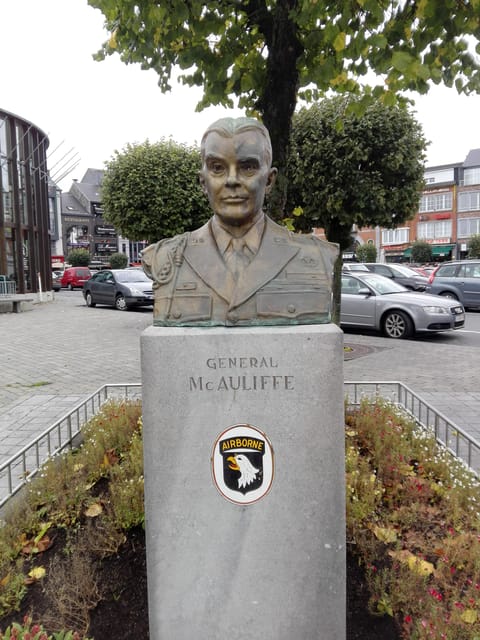
In Bastogne, you visit McAuliffe Square, one of the town’s central points. The square is connected with General Anthony McAuliffe and the famous defense of Bastogne. An imposing M3 Sherman tank provides a strong visual link to the Allied forces that fought here.
The tank is more than a military object for photographs. It helps you grasp the machinery involved in a campaign often remembered through individual soldiers and commanders. Look at its size and shape, then compare it with the narrow streets and ordinary buildings around the square. That contrast brings the battle closer to everyday life.
You have time to walk around the center, and the area has nearby places for dining and shopping. This is also the part of the day where you can take a short break from formal memorials. The stop is not presented as a long guided visit, so do not expect a detailed tour of every street.
Lunch is not included. You should budget for a meal and drinks, and you may find that the timing makes a quick, practical lunch the best choice. The restaurant stop is scheduled for about an hour, which gives you a chance to eat without turning the day into a lengthy restaurant visit.
The Mardasson Memorial, built in the shape of a star
The Mardasson Memorial honors American soldiers killed in the Battle of the Bulge. Its star-shaped design is easy to recognize, and its position near Bastogne makes it one of the central stops of the day.
The memorial is a useful bridge between the town and the museum. At McAuliffe Square, you are in the place where the battle affected a living community. At Mardasson, the focus shifts toward remembrance and the American military effort.
The guided visit is relatively short, listed at about 15 minutes. That is enough to understand the purpose of the monument, but not enough for a slow architectural study. If you like taking photographs, you will want to use the free time around the visit efficiently.
I also appreciate the order of the stops. Seeing the memorial before the museum gives the museum displays more meaning. You have already encountered the names, places, and symbols before entering the galleries.
Other days out of Brussels:
- From Brussels: Guided Day Trip to Bruges and Ghent
★ 4.6 · 8,353 reviews - From Brussels: Bruges & Ghent Day Tour – 2 Fairytale Cities
★ 4.7 · 8,242 reviews - Bruges and Ghent – Belgium’s Fairytale Cities – from Brussels
★ 4.0 · 4,809 reviews - Luxembourg and Dinant Day Trip from Brussels
★ 4.0 · 1,474 reviews
Two hours inside the Bastogne War Museum
The Bastogne War Museum is the main indoor stop, with admission included in the tour price. You have about two hours inside, and that makes this more than a token museum visit.
The museum uses 3D displays and personal stories to explain the campaign. These features can help if you know the broad outline but struggle to follow troop movements, dates, and competing objectives. The guide’s explanation beforehand is valuable here because you enter with a basic framework instead of trying to assemble the entire story from scratch.
I would still plan your time. Two hours is enough to see the main material, but one of the strongest practical points from the day is that some people feel rushed near the end. Do not spend the first hour reading every panel in detail. Start with the main displays, then return to sections that interest you most.
The museum also gives needed balance. The tour focuses heavily on American sacrifice, as it should at the American cemetery and Mardasson Memorial, but the wider Battle of the Bulge involved German forces, Allied armies, civilians, and many different units. The museum helps place the American experience in that larger setting.
For history enthusiasts, this is likely the part that justifies much of the fare. Museum admission is already included, and the guided introduction means your two hours are more useful than a cold visit without background.
The German cemetery and the cost of war
The tour also stops at a German cemetery. That can be an important part of the day because it widens the human picture without excusing the aggression that began the offensive.
A battlefield remembrance trip should not present only one side of the dead. Visiting both cemeteries reminds you that soldiers from opposing armies were killed in the same winter campaign. It also helps you consider how war affects ordinary people on every side, while keeping the political and military responsibility clear.
Expect this to be a reflective stop rather than an entertainment break. The schedule allows time for a visit and sightseeing, but the exact amount of time at each location can vary with the day’s pace.
Foy and the foxholes of the 101st Airborne
The visit to the foxholes near Foy is one of the most distinctive parts of the experience. These cavities in the ground were dug and occupied by American soldiers, including men of the 101st Airborne Division.
Here, the history becomes physical. You can see the rough defensive positions and imagine the limited shelter they offered. The forest setting and uneven ground also make clear why you need sturdy, comfortable footwear and why the tour is unsuitable for people with limited mobility.
This stop may affect you more than a polished monument because it shows the basic conditions faced by the soldiers. There is no grand architecture to distract you. You are looking at earth cut into the ground for protection.
The Foy visit also connects with popular stories about Easy Company, the unit made famous through wartime accounts and later television. The supplied tour information specifically identifies the foxholes as those occupied by the 101st Airborne Division. If that unit interests you, this is a useful place to picture the terrain rather than simply recall scenes from a screen.
Do not expect a long forest hike. The scheduled walk is short, but the footing and outdoor conditions still matter. In wet or cold weather, you will appreciate shoes with good grip and practical clothing.
The bus ride is part of the history lesson
The route from Brussels to the Bastogne area takes about two hours each way, although one guide has described the outbound trip as a little over an hour. Either way, you should prepare for significant coach time.
That is the main trade-off of this trip. Bastogne is far enough from Brussels that a day tour cannot avoid the road. If you dislike long rides, 11 hours may feel demanding. The upside is that you do not need to arrange regional transport, navigate rural sites, or piece together separate museum and memorial visits.
The coach has been rated highly for comfort, with 86 percent of ratings giving the transport a perfect score. The driver is also praised in the feedback, and the guide generally keeps the journey useful with stories and explanations.
I would bring water, a light snack, and something to read, even though the guide provides commentary. Lunch and beverages are not included, and the day has enough scheduled stops that a small personal supply can make the ride easier.
Is $97 good value?
At $97 per person, this is a solid price for an 11-hour guided excursion. The fare includes the bus, an English-speaking guide, and admission to the Bastogne War Museum. It does not include lunch or drinks, so your real spending will be a little higher.
The value comes from the logistics. You are not just paying for a ride to Bastogne. You are reaching cemeteries, memorials, a German burial site, the Foy foxholes, and the museum in one day. Some of these places would be difficult to combine without a private vehicle.
A self-guided visit might cost less if you are already based in the Ardennes, but from Brussels you would need to manage the transport and timing yourself. For a first visit to the battlefield, the guide’s historical explanation is an important part of the package.
Private hotel pickup and drop-off are available only if you select the private option. The standard meeting point is outside the National Bank of Belgium, and the tour finishes at Brussels Central Station. Check the exact option before booking if door-to-door service matters to you.
Who will enjoy this day most?
I would recommend this tour to anyone with a serious interest in the Second World War, military history, family connections to the campaign, or battlefield memorials. It also suits visitors who want a structured introduction to Bastogne without renting a car.
The day works especially well if you value explanation. Martin King has been praised for his energy and command of the subject, while Stefan has been praised for building the story before the museum visit. Jan, another guide named in the feedback, was also noted for his flexibility and willingness to add a stop connected with a family wartime connection.
You should think twice if you want a relaxed day with plenty of free time. Bastogne itself receives only part of the schedule, and the museum may feel rushed if you read every display. The walking, uneven ground, and long coach ride also make this a poor fit for anyone with limited mobility.
The tour is conducted in English. Free cancellation is available up to 24 hours before departure, and you can reserve now and pay later, which helps if your Brussels plans are still shifting.
Should you book the Battle of the Bulge tour?
Book it if you want the full chain of remembrance: cemetery, town, memorial, museum, opposing cemetery, and battlefield positions. The combination is what makes the day worthwhile, and the included museum entry improves the value of the $97 price.
Skip it if you need a short outing, dislike several hours on a coach, or cannot manage uneven walking. For everyone else, this is a serious and well-planned history day, with strong guides, good transport, and enough time at the key sites to understand why Bastogne remains such an important name.
FAQ
Where does the tour begin?
The meeting point is Bd de Berlaimont 18, outside the National Bank of Belgium. Look for the tour staff and the Keolis coach.
Where does the tour finish?
The tour finishes at Brussels Central Station.
How long does the experience last?
The tour lasts 11 hours.
What language is the tour conducted in?
The live tour guide speaks English.
Is admission to the Bastogne War Museum included?
Yes. Entrance to the Bastogne War Museum is included in the tour price.
Is lunch included?
No. Lunch and beverages are not included, though the schedule includes about one hour for lunch at a local restaurant.
What sites are included?
The tour includes the Neuville-en-Condroz American Cemetery, Bastogne and McAuliffe Square, the Mardasson Memorial, the Bastogne War Museum, a German cemetery, and the foxholes near Foy.
What should I bring?
Bring comfortable shoes. The tour includes walking at cemeteries, memorials, Bastogne, and the foxhole site.
Is the tour suitable for wheelchair users?
No. The activity is not suitable for wheelchair users or people with mobility impairments.
Just added in Brussels
- Standard vehicle from Brussels airport to city of Antwerp★ 5.0 · 4 reviews
- Luxury vehicle from Brussels airport to the city of Brussels★ 4.0 · 5 reviews
- Transfer Brussels Airport (BRU) –> City Center 7 PAX (ONE WAY)★ 5.0 · 7 reviews
- Transfer Brussels Airport –> Brussels MB V Class 7 PAX (ONE WAY)★ 5.0 · 4 reviews
- PRIVATE MPV TRANSFER FROM/TO BRUSSELS AIRPORT (Max 6 pax) ONE-WAY★ 5.0 · 4 reviews
- Luxury Minivan from Brussels airport to the city of Brussels★ 4.0 · 7 reviews
- Transfer Brussels Airport –> City MB E Class 1-3 PAX (ONE WAY)★ 5.0 · 6 reviews
- Brussels: City Walk with Audioguide in 7 Languages on your Phone★ 3.5 · 4 reviews
WWI Battlefield Tours, compared.
Great War Flanders Fields Minibus Tour w/ Lunch
Read our review →
Flanders Fields Remembrance Tour from Brussels
Read our review →

In Flanders Fields and Passchendaele Half Day Morning Tour
Read our review →
An exploration of the deadly salient battlefields
Read our review →
Remembrance Tour: The Battle of the Bulge in the Ardennes
Read our review →Browse the lists this tour appears in