
Reviewed · HISTORICAL TOURS
Bruges at Night: Murder, Mystery & Dark Stories Small Group Walk
Bruges looks almost made for a night walk, but this tour gives you more than pretty canals and glowing medieval façades. Along the route, your guide connects the city’s old squares, pubs, bridges, and waterways with stories about murders, ghosts, devils, eels, traders, and strange local customs. It is part evening stroll, part folklore show, and part introduction to Bruges beyond the usual postcard views.
I like two things in particular. First, the small group is capped at 15 people, which makes it easier to hear a guide such as Sophie, Pascal, Andy, or Alistair and ask questions. Second, the walk reaches corners many daytime city tours skip, including the old Spanish district, the canal warehouses at Spiegelrei, and Bruges’s oldest pub. The main drawback is that the title promises more murder and mystery than the tour always delivers. You get dark stories, but plenty of the evening is also devoted to history, architecture, food, beer, and local recommendations.
Key details of the Bruges night walk
- The route ends at Jan van Eyckplein, an old Bruges harbor surrounded by photogenic canals and former merchant warehouses.
- The group is limited to 15 people, a useful size for a storytelling tour where hearing every detail matters.
- The walk lasts about two to two and a quarter hours, with much of the time spent outdoors.
- The stories mix humor, folklore, and history, so this is not a pure crime tour.
- The route includes lesser-seen places, such as Pottenmakersstraat, Augustine Bridge, Gouden-Handrei, and Vlissinghe.
- Admission fees are not included for places such as the Belfry, Bruges Beer Experience, Town Hall, Frietmuseum, and Huis Den Noodt Gods.
Why Bruges works so well after dark
Bruges is beautiful in daylight, but evening changes the pace. The crowds thin out around the Markt and Burg Square, the canals become darker and more reflective, and the city’s narrow streets feel better suited to tales of old crimes and local legends.
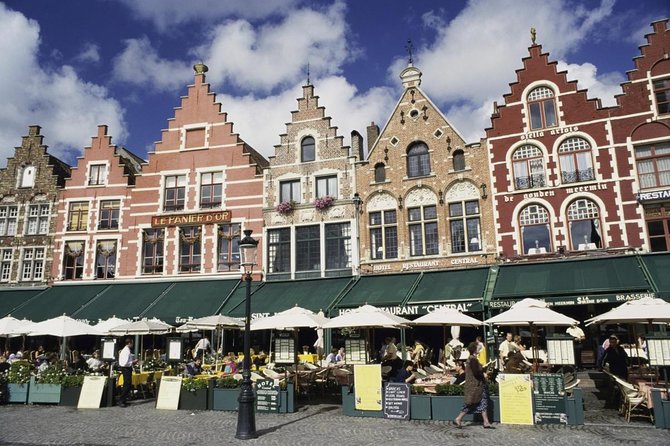
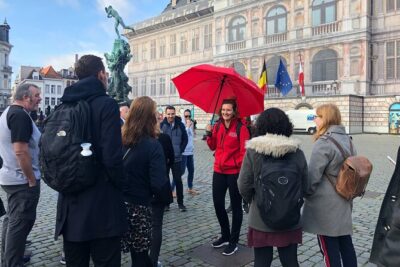
You begin at Market Square, directly in front of the Belfry. This is a convenient meeting point because the tower is easy to identify, and it places you at the center of medieval Bruges. The guide starts with the importance of the Belfry as a civic tower, a symbol of the city’s wealth and independence. You do not go inside, and admission is not part of the tour, but the building gives the evening a strong opening image.
From there, you move through the historic center and across the Markt. The first few minutes are used for introductions and a quick outline of Bruges’s past. This opening matters because the later stories make more sense once you understand how trade, religion, politics, and city power shaped the streets around you.
The evening timing is a major reason to book. You can see the same central sights as a standard walking tour, but with fewer people around. Keep one qualification in mind: in summer, the tour may begin before full darkness. One person noted that the buildings were not yet lit during a summer evening. You still get the quieter atmosphere, but do not assume every departure will feel like midnight Bruges.
More Historical Tours in Bruges
- Historical Walking Tour: Legends of Bruges
★ 5.0 · 2,541 reviews - Evening Tour: The Dark Side of Bruges
★ 5.0 · 956 reviews - THE Storytelling Tour of Bruges | First Day Must | History & Tips
★ 5.0 · 925 reviews
From beer stops to Burg Square
After the Markt, the route pauses near the Bruges Beer Experience. The guide explains why the museum and its bar are worth considering, but the visit itself is not included. This is a short stop, not a tasting session, so think of it as a useful pointer for later in your stay.
The same goes for Staminee De Garre. You stop near the entrance and learn why this small bar is worth seeking out for a Belgian beer. The guide is not simply marching you past sights. You are also collecting practical ideas for after the tour, which is helpful if you have only one evening in Bruges and want to choose a good place without wandering at random.
At Burg Square, the tour slows down. This is described as the birthplace of the city around 1,200 years ago, and it gives your guide room to explain how Bruges grew from an early settlement into a major medieval center. The square contains some of the city’s most important civic and religious buildings, so it is a good place to connect Bruges’s political past with its grand architecture.
The Town Hall receives only a brief stop, and you do not enter. It is one of the oldest town halls in the Low Countries, so even a short explanation adds context to the façades around the square. If you want a detailed look inside, plan a separate visit during the day.
Bars, fries, and the beginnings of capitalism
The tour keeps its tone light by mixing darker tales with food and drink. Bar Rose Red is introduced as one of Bruges’s most romantic bars, while the Frietmuseum is pointed out as the place to learn about Belgian fries. Neither stop includes a museum visit, and both are quick, but they help you build a list of places to return to.
That balance is one of the walk’s strengths. You are not listening to grim crime stories for two straight hours. You get the odd, the funny, and the useful side by side. One moment may involve a ghost story, and the next may involve where to find Flemish beef stew or a bar with more than 400 Belgian beers.
At Huis Ter Beurze, the guide turns to Bruges’s role in early commerce. The name is tied to the city’s old trading activity and helps explain why Bruges is sometimes described as a cradle of capitalism. This is one of the more interesting historical turns in the walk because it moves beyond kings and churches. You begin to see Bruges as a working commercial city, not just a preserved beauty.
The route also points out a pool pub and Belgian beer bar, followed by Groot Vlaenderen, a cocktail bar in a building with an unusual past. These stops are brief, but they show how old buildings continue to function as part of modern Bruges. If you are staying in town, the recommendations can be as useful as the stories.
Pottenmakersstraat and the old Spanish district
At Pottenmakersstraat, the guide explores a corner described through the ideas of the first, the last, and the oldest. The wording hints at a local story tied to the street corner, and this is the sort of small-scale detail that gives the tour its character. You are no longer just looking at the grand squares. You are learning how odd facts and local memory attach themselves to ordinary streets.
The walk then reaches Augustine Bridge, or Augustijnenbrug. This area was once the heart of the Spanish district in Bruges. The stop helps explain the city’s international connections and the groups who lived and worked here.
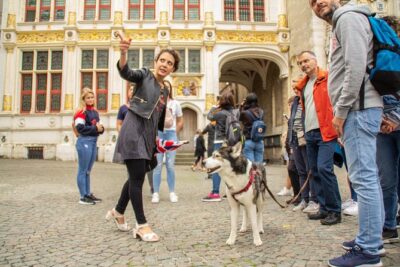
These quieter sections are where the small group helps. A guide can pause, explain a detail, and adjust the pace without losing a large crowd. Guides such as Pascal, Sophie, Andy, Arthur, and Alistair have been praised for making the past feel human through stories rather than a long list of dates. Nick has also been noted for tailoring the walk to a small group and helping two people check their train platform at the end. That kind of practical attention can make a difference when your evening schedule is tight.
Other ways into the past around Bruges:
- Historical Walking Tour: The Story of Bruges – by Legends
★ 4.7 · 483 reviews - Private Historical Tour: The Highlights of Bruges
★ 5.0 · 315 reviews - 2-Hour Historical Walking Tour in Bruges with Praline Included
★ 5.0 · 291 reviews - Bruges: Historium Bruges Medieval Experience Ticket
★ 4.3 · 220 reviews
Ghost house, devilish eels, and canal folklore
Huis Den Noodt Gods is also known as the ghost house of Bruges. You do not enter, and admission is not included, but the exterior provides the setting for one of the tour’s more atmospheric moments. This is the sort of stop that works best after sunset, when an old building and a strange story can make you look twice at details you might otherwise pass without noticing.
At Gouden-Handrei, the guide tells the tale of eels in the canals. Local belief once held that the eels were snakes placed in the water by Satan. It is an entertaining example of how people explained unfamiliar creatures and dark waterways before modern knowledge made the natural world less mysterious.
One guide, Sophie, has used an iPad to show old maps, earlier images of buildings, and material connected with local legends. She has also acted out parts of stories, including climbing down steps to recreate a position from one tale. You should not expect every guide to use the same props or style, but the strongest guides on this route treat storytelling as a small performance. Pascal has been praised for a theatrical approach, while Andy and Alistair are known for an energetic, humorous delivery.
This is also where expectations matter. If you want a serious investigation of documented murders, this may feel too light. The tour uses murder and mystery as a theme, but its actual content is broader. You will hear spooky tales and curious legends, yet much of the evening is about how Bruges developed and how local people remember its past.
Vlissinghe and Bruges’s oldest pub
Vlissinghe is the culmination of the route. The stop explains why this place matters and points you toward one of the city’s oldest pubs. The itinerary does not include a drink or a pub visit, so you will need to return on your own if you want to go inside.
This final recommendation is valuable because it gives the tour a natural afterlife. You finish with a clear idea of where you might eat or have a beer, rather than simply returning to the same central square. The route has already mentioned Flemish beef stew, Belgian beer, cocktails, and fries, so you can choose the kind of evening you want after the walk.
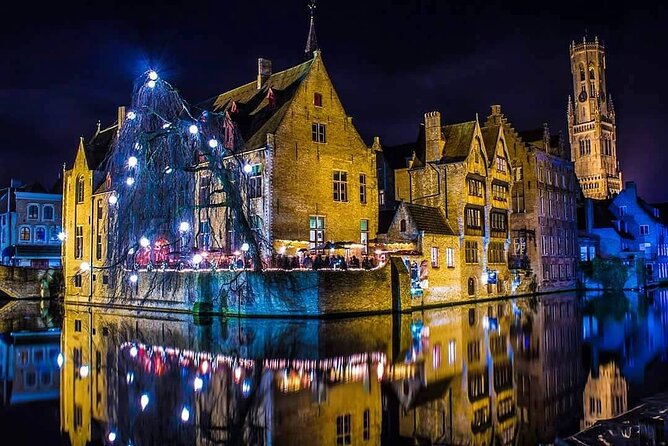
The final stretch runs through Spiegelrei and ends at Jan van Eyckplein. Spiegelrei is especially good for photographs. Former warehouses once used by wealthy traders line the canals, and their reflections create one of the prettiest scenes on the route.
Jan van Eyckplein was one of Bruges’s old harbors. It is a fitting end because the square connects the city’s beauty with its commercial past. The tour starts among Bruges’s civic symbols and finishes beside the waterways that helped make the city wealthy.
How the guide affects the experience
This is a storytelling tour, so your guide matters a great deal. The strongest feedback centers on guides who combine facts with humor, energy, and a sense of theater. Sophie has been described as passionate and creative, with a talent for making legends feel immediate. Pascal is known for animated storytelling and useful recommendations. Andy, Alistair, and Arthur have also received praise for making the city’s past easy to follow and remember.
The tour is conducted in English. Since the group can include up to 15 people, you should be able to follow the talk without the strain of a large crowd, though staying near the guide is still sensible.
The walk also works well for solo visitors. The small format makes it easier to speak with others, and the guide can answer questions without the impersonal feel of a large group. Families with older children and adults who enjoy folklore will likely get the most from it. People who prefer a quiet, self-guided walk may find the steady storytelling less appealing.
Is $42.33 a fair price?
At $42.33 per person, this is not the cheapest way to see Bruges. You are paying for a guided evening experience, not entry to a museum, a meal, or a beer. The Belfry, Beer Experience, Town Hall, Frietmuseum, and Huis Den Noodt Gods all list admission separately or are simply viewed from outside.
I think the price can be fair if you value a small group and an engaging guide. A two-hour walk with a maximum of 15 people gives you more personal attention than a large free walk, and the route includes areas you may not think to find by yourself. The guide’s recommendations can also save time during the rest of your stay.
The value is weaker if you only want a quick look at the main sights. Bruges is compact, and you can walk around much of the center without paying for a guide. Book this experience for the stories, local folklore, and route beyond the most obvious squares, not simply for transportation from one landmark to another.
Practical advice before you go
Wear comfortable shoes. The route covers a lot of ground over roughly two hours, and the walk continues in poor conditions unless the operator cancels for weather. Bring a raincoat or umbrella when rain is possible, since the entire experience is outdoors.
Allow extra time for photographs. Bruges’s canals, Jan van Eyckplein, Spiegelrei, and Burg Square deserve more than a quick glance, but the group needs to keep moving. You can return to your favorite spots after the tour.
The meeting point is Market Square, or Markt, in front of the Belfry. The tour ends at Jan van Eyckplein, only a few minutes from the starting area. That makes the route easy to fit into a central Bruges evening.
You receive confirmation at booking, and mobile tickets are supported. Service animals are allowed, public transportation is nearby, and most people can participate. You may cancel for a full refund up to 24 hours before the start time. If poor weather or insufficient bookings force a cancellation, you are offered another date or a full refund.
Should you book the Bruges at Night walk?
Book it if you want folklore, local stories, canal views, and practical bar and food tips in one evening. It is especially useful on a first visit, for a solo visit, or when you have limited time and want a guide to point out places you might miss.
Skip it if you want a strict murder-investigation tour, indoor museum access, or a silent photography walk. The experience is broader and lighter than its title suggests. It works best when you enjoy a guide who can move from a ghost house to Belgian fries, from medieval trade to devilish eels, and from serious history to a good pub recommendation without taking the evening too seriously.
FAQ
How long does the Bruges at Night walk last?
The experience lasts about two hours to two hours and 15 minutes. Some descriptions and accounts place the walk closer to two and a half hours, so avoid scheduling an immediate commitment afterward.
Where does the tour begin?
It begins at Market Square, or Markt, in front of the Belfry of Bruges in central Bruges.
Where does the tour end?
The walk ends at Jan van Eyckplein, an old harbor area in Bruges. It is only a few minutes from the starting point.
Is the tour offered in English?
Yes. An English-speaking guide leads the experience.
How many people can join the tour?
The group has a maximum of 15 participants.
Are admissions to the museums and buildings included?
No. Admission is not included for places such as the Belfry, Bruges Beer Experience, Town Hall, Frietmuseum, and Huis Den Noodt Gods. Most stops are exterior explanations or recommendations.
Is the tour suitable in rainy weather?
The experience takes place outdoors and requires good weather. If the operator cancels because of poor weather, you are offered another date or a full refund.
Can I cancel for a full refund?
Yes. You must cancel at least 24 hours before the experience begins to receive a full refund. Changes or cancellations made less than 24 hours before the start time are not accepted for a refund.
Just added in Bruges
- 2-Hour Private Walking Tour of Bruges★ 5.0 · 13 reviews
- Ticket Expo Body Worlds in Bruges, Belgium★ 4.5 · 11 reviews
- 6 Hour Bruges Shore Excursion from Zeebrugge Cruise Port★ 4.5 · 23 reviews
- Explore the Instaworthy Spots of Bruges with a Local★ 5.0 · 3 reviews
- The Waffles ‘n Coffee Breakfast in Bruges Centre★ 4.5 · 9 reviews
- Australian Battlefields Private Tour in Flanders from Bruges★ 5.0 · 15 reviews
- Discover the secrets of Bruges by playing!★ 4.5 · 7 reviews
- Bruges Walking Tour with Audioguide on Your Smartphone★ 4.5 · 14 reviews
Historical Tours, compared.
Historical Walking Tour with Chocolate & Waffle Tasting
Read our review →
THE Storytelling Tour of Bruges | First Day Must | History & Tips
Read our review →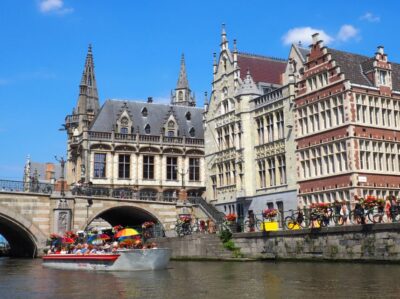
Browse the lists this tour appears in