
Reviewed · HISTORICAL TOURS
Private Tour: The Dark Side of Gent
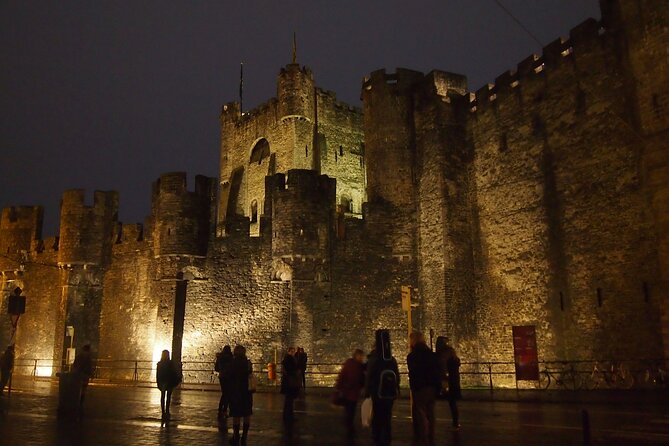
Ghent’s dark side is less about horror than the hard edges of city life: executions, religious conflict, power struggles, Viking raids, and the social cost of industrialization. After sunset, the medieval center feels quieter and more atmospheric, giving you time to study the towers, canals, bridges, and old stone walls without the daytime rush. The private format lets your guide adjust the pace and answer your questions.
I like the route’s two clear strengths: it covers a large slice of central Ghent in just 1 hour 45 minutes, and it ends in Patershol, a handy quarter for a drink or dinner. Guides such as Kenny, Sébastien, Deborah, Isabelle, and Jerke have been praised for warmth, humor, and strong local knowledge. The main caution is that the dark material can be milder than the title suggests. One unhappy customer found it simply an evening city walk rather than a truly macabre tour.
Key points at a glance
- Private walking route: Only your own group takes part, so you can ask questions and set a comfortable pace.
- Ten central stops: The walk links St. Michael’s Bridge, the three towers, Gravensteen, the medieval harbor, and Patershol.
- Dark stories with wider context: Expect tales of executions and religious conflict, alongside trade, architecture, defense, and industry.
- Evening atmosphere: Ghent’s streets are generally less busy at night, and the illuminated center adds mood to the walk.
- Useful first-night orientation: The route gives you a broad look at central Ghent before you explore on your own.
- Ends near food and drink: Patershol is close to many city bars and restaurants, making dinner an easy follow-up.
Ghent after sunset, with the sharp edges left in
This is a city walk built around stories. You are not entering a dungeon or touring a museum after hours. You are moving through public streets and squares while a guide explains how Ghent became wealthy, powerful, divided, defended, and eventually renewed.
That distinction matters. If you want graphic ghost tales at every corner, this may feel restrained. If you prefer legends tied to real places and broader history, the route has more substance. The stories are anchored in bridges, churches, fortifications, canals, and old quarters rather than delivered as free-floating spooky tales.
The evening timing helps. Ghent is famous for its medieval center, but daytime crowds can make it harder to appreciate the scale of the old city. At night, the route has a calmer feel, and the stone buildings take on a more dramatic character. You also avoid spending the whole tour in the busiest lanes.
The walk is private, which is a major part of the price. You are not sharing the guide with a large group, and the guide can respond to your interests. Ask more about medieval trade, Charles V, religious conflict, or the city’s architecture, and the conversation can follow that thread. Families also have a reason to consider it: Kenny was specifically praised for keeping children engaged, and the mix of stories gives younger listeners more variety than a straight architectural tour.
More Historical Tours in Ghent
- Ghent: 50-Minute Medieval Center Guided Boat Trip
★ 4.5 · 5,637 reviews - Historical Walking Tour: Legends of Gent
★ 5.0 · 1,761 reviews - Ghent: 40 Minute Medieval Center Guided Boat Tour
★ 4.4 · 884 reviews
Starting at St. Michael’s Bridge
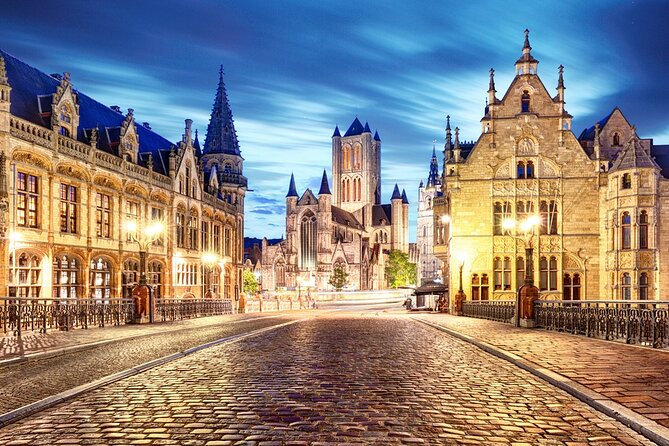
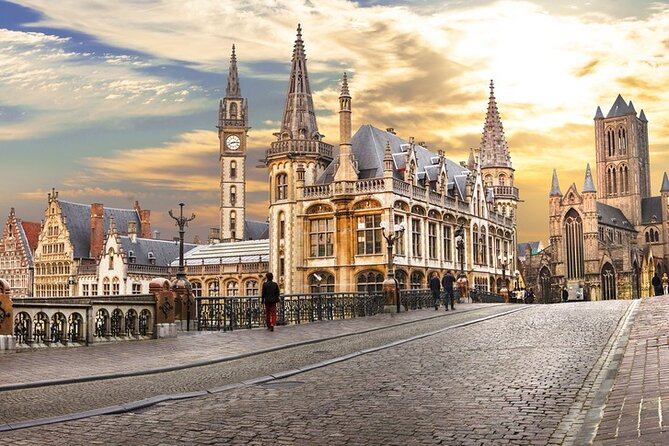
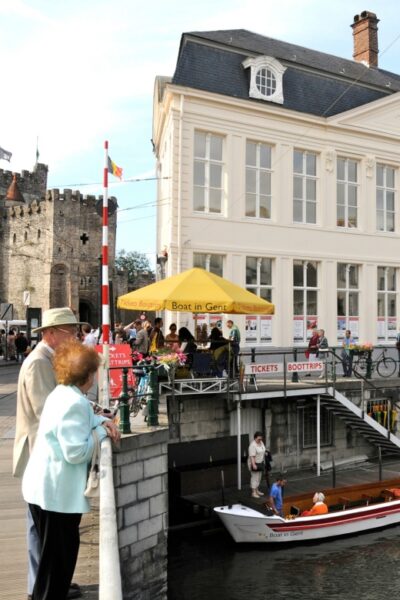
The meeting point is Hostel Uppelink on Sint-Michielsplein, beside St. Michael’s Bridge. This is an excellent place to begin because the bridge gives you one of the clearest views of Ghent’s famous skyline.
Your guide starts with the city’s role as a medieval trading center, then points out the three towers that define the central view: St. Nicholas’ Church, the Belfry, and St. Bavo’s Cathedral. You get the basic map of the old center before the walk moves into its individual stories.
Allow about 15 minutes here. The stop is free, and it does more than provide a photo opportunity. It explains why Ghent grew in the first place and helps you recognize the major landmarks as the route continues. If you arrive early, this is also a useful place to get oriented.
St. Bavo’s Cathedral and the Devil’s Tower
The next stop is St. Bavo’s Cathedral, where the guide tells the grim story behind its nickname, the Devil’s Tower. The tour does not include entry, so you will be hearing the story from outside.
That limitation is worth noting. If you want to see the cathedral interior, the Ghent Altarpiece, or other church details, plan a separate visit. This stop is about the tale and the building’s role in the city, not an indoor sightseeing visit.
The ten-minute presentation keeps the pace moving. You get a darker episode without spending too long at one site, which is useful on a compact evening route.
Graslei and Korenlei, Ghent’s medieval harbor
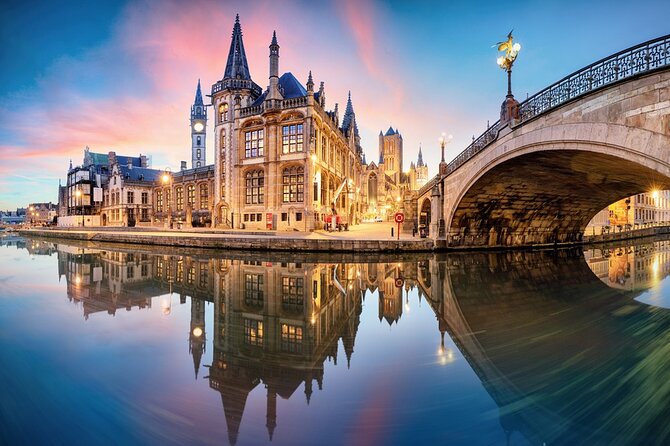
At Graslei and Korenlei, the story shifts from religious fear to money. These canal-side quays formed the heart of medieval Ghent’s harbor, when the city was a major economic force in Europe.
The guide explains the trading activity that helped pay for Ghent’s churches, defenses, and grand civic buildings. This is one of the most useful stops because it shows that the city’s beauty did not appear by accident. Wealth, commerce, taxation, and control of trade shaped the center you see today.
The quays are also among the most attractive parts of the walk. At night, the water and historic facades create a strong setting for the story. You have ten minutes here, enough for a focused explanation and a quick look around, but not enough for a relaxed canal-side linger.
Other ways into the past around Ghent:
- Evening Tour of the Dark Side of Gent
★ 5.0 · 646 reviews - Ghent: 40-Minute Historical Boat Tour of City Center
★ 4.3 · 430 reviews - Private Historical Tour: The Best of Ghent
★ 5.0 · 115 reviews - Bicycle tour in historic Ghent
★ 5.0 · 87 reviews
The Appelbrug legend and the Butchers’ Hall
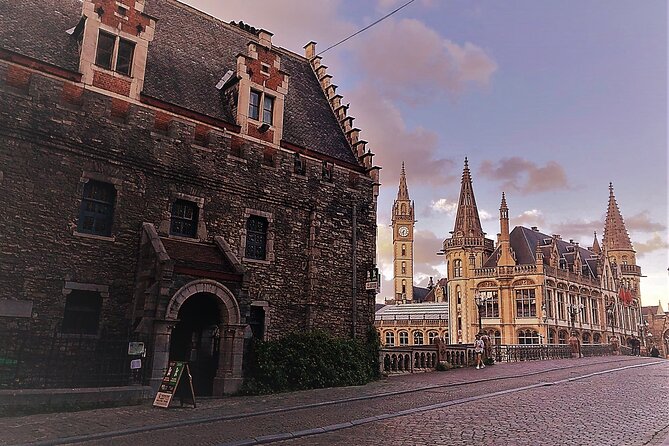
At Appelbrugparkje, the route pauses on a bridge overlooking the large Butchers’ Hall. Here the guide tells the legend of a father and son facing execution, followed by the miraculous event that saved them.
This is the point where the tour most clearly leans into local legend. The value is not only in deciding whether the story is true. It is in seeing how old cities preserve dramatic tales around specific streets and buildings, then pass them on as part of local identity.
The stop lasts about ten minutes and is free. The bridge gives you a different view of the center, away from the grandest postcard angles. Watch your footing and keep your attention on the guide, since this is a public urban setting rather than a closed tour space.
Gravensteen, the castle that shaped the city
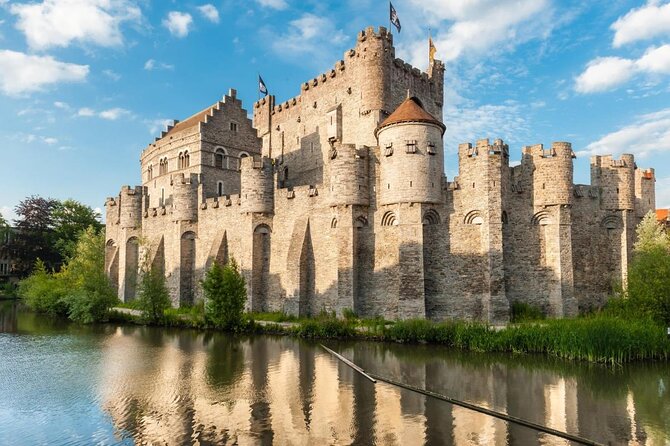
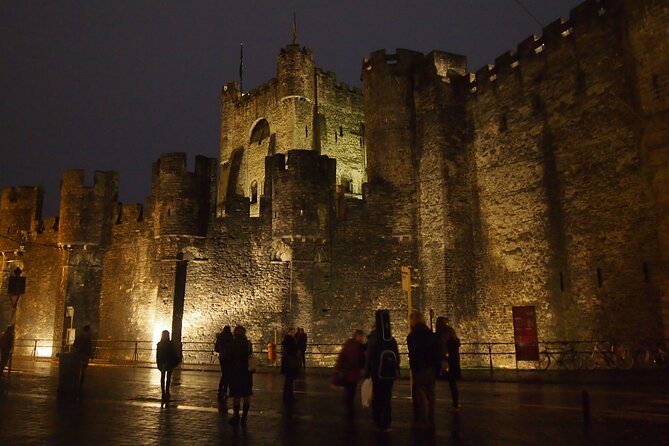
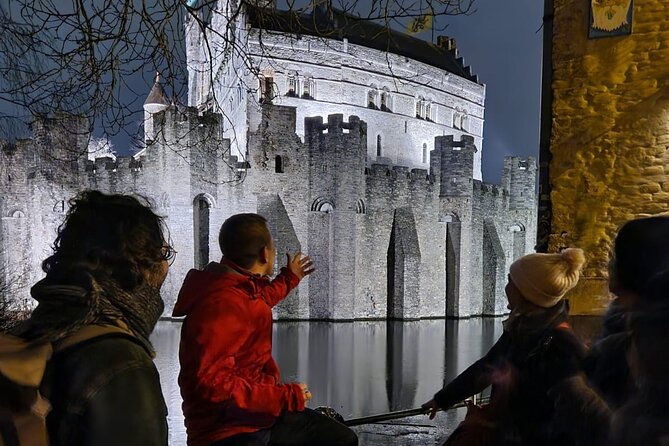
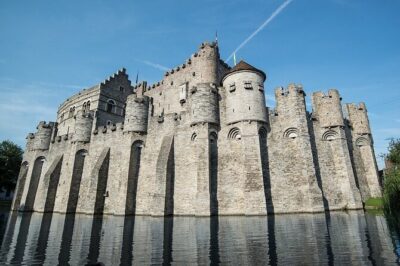
Gravensteen is the route’s biggest architectural stop. The fortress was built by Count Baldwin in the ninth century to protect the area from Viking raids, and the settlement began to grow around this defensive stronghold.
You will hear about the castle’s role in Ghent’s development while viewing it from outside. Entry is not part of the walk, so you should not expect to tour the rooms, walls, or exhibits during this experience.
Still, an exterior explanation gives the castle useful context. Instead of seeing Gravensteen as an isolated medieval attraction, you learn how defense influenced the city’s early growth. The ten-minute stop is enough to connect the fortification to Ghent’s wider story without turning the evening into a castle visit.
If Gravensteen is high on your list, make time for a separate admission visit. The private walk can tell you why it matters, but it does not replace going inside.
Prinsenhof and the vanished palace
The route continues to Prinsenhof, once the site of a huge palace known as the Prince’s Court. Much of the original complex is no longer visible in an obvious form, so this stop asks you to use your imagination.
That can be either a strength or a weakness. A strong guide can make a vanished palace feel present through clear explanation and local detail. A visitor looking only for intact medieval buildings may find the stop less immediately rewarding than Gravensteen or the three towers.
The guide’s storytelling is especially important here. Several guides associated with this experience, including Sébastien, Deborah, Isabelle, and Jerke, have been praised for making historical material conversational rather than stiff. That style matters most at places where the physical remains are limited.
Rabot Sluice and the old defensive wall
At Rabot Sluice, you see the only remaining tower from the 14-kilometer defensive wall built around Ghent during the Middle Ages. This stop widens the story beyond the central landmarks.
The surviving tower gives you a sense of how large the city’s defenses once were. Ten minutes is not enough to reconstruct the entire wall, but the guide can show how much effort went into protecting Ghent and controlling movement around it.
This is also one of the route’s less obvious points. You are not simply moving from one famous monument to another. The walk includes remnants that help explain the city’s former size, fears, and military needs.
Charles V on the Bridge of Imperial Delights
The stop called Keizer Karel takes you to the Bridge of Imperial Delights. Four sculptures show legendary scenes from the life of Charles V, the powerful ruler closely tied to Ghent.
Your guide explains some of these scenes and adds a personal angle to the monument. This is a good example of the tour’s blend of large political history and small visual clues. You do not need prior knowledge of Charles V to follow the explanation, and the sculptures give you something concrete to inspect as you listen.
As with the other ten-minute stops, the presentation is brief. You will get selected stories rather than a full biography. That keeps the walk lively, but you may want a separate visit or reading if Charles V is a special interest.
Augustijnenklooster and religious conflict
At Augustijnenklooster, the tour turns to the Religious Wars and the effects of Calvinist rule on Ghent. This is one of the more serious sections because it deals with conflict over belief, power, and control of the city.
The building is not entered during the walk. The guide explains its troubled past from outside, so the interest comes from the story and the setting rather than interior art or architecture.
This stop gives the dark theme more weight. Ghent’s difficult past was not limited to crime or executions. Religious division altered public life and left a lasting mark on the city. If you prefer historical cause and effect to isolated scary tales, this will likely be one of the strongest parts of the route.
Ending in Patershol
The final stop is Patershol, the medieval quarter known as Monk’s Hole. Here the subject changes again, this time to the Industrial Revolution and its social effects.
The tour explains how industrial change affected the city and contributed to its later economic revival. That ending is smart because it prevents the walk from treating Ghent as a frozen medieval stage set. You see how the old center survived changing industries, populations, and fortunes.
Patershol is also a practical place to finish. The tour ends in the city center near many cozy bars and restaurants, so you can continue the evening without arranging a ride. If you are staying in Ghent, this is a useful way to turn a history walk into a dinner plan.
What $105.59 per person really buys
At $105.59 per person, this is not a bargain city orientation if you are traveling alone or as a pair. The price reflects a private guide for your group, not simply admission to attractions. The value improves when several people share the booking, especially since group discounts are available.
I would judge the cost by the quality of the guide and your interest in conversation. Guides named in the feedback, including Kenny, Jerke, Hamraz, Isabelle, Sébastien, and Deborah or Debra, have been praised for being warm, funny, patient, and able to explain Ghent in clear English. One guide was especially appreciated for answering every question, including the silly ones. That is exactly where a private walk earns its keep.
You are also covering ten stops in 1 hour 45 minutes. The route is efficient, but it is not slow sightseeing. Each stop receives about ten minutes, with 15 minutes at St. Michael’s Bridge, so you should expect a steady walking pace and short explanations rather than long visits.
The strongest value comes if you use it early in your stay. One person who booked it on a first evening found it useful for getting a feel for the city, and another wished they had not waited until the last night. I agree with that advice. Take the tour near the start, then return to the places that catch your interest.
Who should book this private night walk
I would recommend it to you if you want:
- A first look at central Ghent with a local English-speaking guide
- History that includes legends, executions, religious conflict, and political power
- A private format where you can ask questions freely
- An evening activity that works for families as well as adults
- A route that finishes near dinner and drinks
- A guide who can connect famous landmarks with less obvious corners
Families should find the variety helpful. The castle, legends, bridges, sculptures, and darker tales provide several ways into the city’s past. The route is also short enough to fit into an evening, though children still need to manage nearly two hours of walking.
You should think twice if you want a dedicated ghost tour with repeated frightening stories. The title promises a dark angle, but much of the walk is a general history tour told after sunset. The material can be grim, but it also covers trade, defense, architecture, religion, and economic change.
The route is near public transportation, and most people can participate. Service animals are allowed. Since the tour takes place outdoors and includes walking between ten stops, wear sensible shoes and be ready for an urban stroll.
Booking timing and cancellation
The tour is offered in English, with mobile tickets and confirmation at booking. It is commonly reserved well ahead of time, with an average booking lead of 49 days, so popular evening slots may be worth arranging before your trip.
You can cancel for a full refund up to 24 hours before the local start time. Cancellations or changes made inside that window are not accepted for a refund.
Should you book The Dark Side of Gent?
Book it if you want a private evening introduction to Ghent that uses dark legends as a doorway into the city’s larger story. The strongest parts are the guide-led storytelling, the atmospheric route, the clear skyline view from St. Michael’s Bridge, and the finish in Patershol.
Skip it if you expect a theatrical horror production or extensive access inside the cathedral, castle, monastery, or palace sites. You will see those places from the outside and hear their stories.
For most first-time visitors who value personal guidance, I think the tour is worth considering, especially when shared among a group. Choose it early in your stay, listen for the details behind the legends, and keep Patershol open for dinner afterward.
FAQ
How long is The Dark Side of Gent tour?
The tour lasts approximately 1 hour 45 minutes.
Is this a private tour?
Yes. Only your own group participates in the activity.
What language is the tour offered in?
The tour is offered in English.
Where does the tour start?
It starts at Hostel Uppelink, Sint-Michielsplein 21, 9000 Gent, Belgium.
Where does the tour end?
It ends in the Patershol area of central Ghent, near bars and restaurants.
Does the tour include entry to St. Bavo’s Cathedral?
No. Entry to St. Bavo’s Cathedral is not included.
Can I enter Gravensteen during the tour?
No. The route discusses Gravensteen from outside, and admission is not included.
Is the tour suitable for children?
Most people can participate, and the experience has been described as enjoyable for children. The walk includes several outdoor stops and lasts nearly two hours.
What is the cancellation policy?
You can cancel at least 24 hours before the local start time for a full refund. Cancellations or changes made less than 24 hours before the start are not accepted for a refund.
Just added in Ghent
- Historic Highlights, by a local guide★ 5.0 · 9 reviews
- Discover Ghent while playing! Escape game – The Walter case★ 4.5 · 4 reviews
- Walking Food Tour in Ghent★ 5.0 · 13 reviews
- Discover Ghent while playing! Escape game – The alchemist★ 4.0 · 4 reviews
- Ghent Walking Tour with Audioguide on Your Smartphone★ 4.5 · 13 reviews
- e-Scavenger hunt Ostend: Explore the city at your own pace★ 4.5 · 10 reviews
- Discover Mons while playing! Escape game – The alchemist★ 4.0 · 5 reviews
- e-Scavenger hunt Mons: Explore the city at your own pace★ 5.0 · 4 reviews
Historical Tours, compared.

Historical Walking Tour with Chocolate & Waffle Tasting
Read our review →
THE Storytelling Tour of Bruges | First Day Must | History & Tips
Read our review →
Browse the lists this tour appears in