
Reviewed · WALKING TOURS
Visite guidée : Bruxelles, 1000 Ans de Luttes
Brussels’ Marolles district tells a different story from the postcard center. This walking tour links a 12th-century church, the unfinished renovation of the Palace of Justice, a fine city view, and the famous flea market into a story about poverty, protest, and local pride. Guides such as François, Simon, and Thomas bring the area to life with social history and sharp anecdotes.
I like the local point of view, especially the way the tour explains how people in the Marolles fought to keep their neighborhood from being erased. I also like the low price, the small maximum group of 25, and the useful finish at Place du Jeu de Balle, where you can stay for a drink or meal.
The main consideration is that this is a walking tour about struggle and urban change, not a grand-monument checklist. The Palace of Justice stop is mainly an outdoor explanation, and the short itinerary leaves limited time at each site.
Key points at a glance
- A social-history walk: Learn how working people, poorer residents, and fiercely independent locals shaped the Marolles.
- Four central stops plus a market square: The route connects Notre-Dame de la Chapelle, the Palace of Justice, the Marolles elevator, the district itself, and Place du Jeu de Balle.
- A memorable Palace of Justice story: The guide explains the decades-long renovation scandal and the public money tied up in it.
- An easy two-hour route: The walk starts at Rue de la Chapelle 21 and ends in the middle of Place du Jeu de Balle.
- Useful for locals as well as first-time visitors: The tour adds context even if you have already seen Brussels’ main sights.
- Strong value at $3.62: A €10 gratuity is not included, so budget for that if you want to follow the suggested tipping practice.
Why the Marolles is the right place for this tour
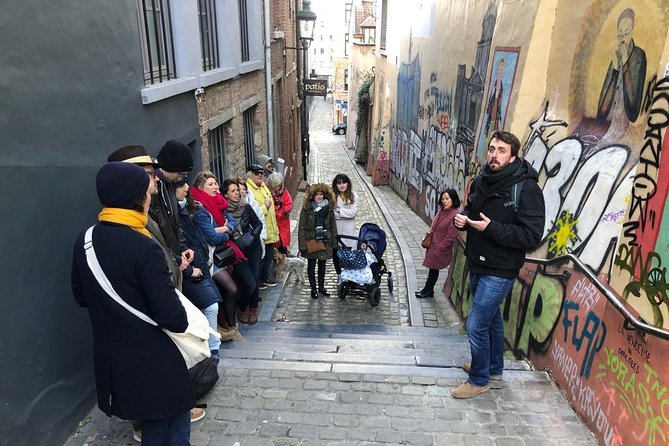
Brussels can be hard to read at street level. The monumental center tells you about kings, commerce, and grand civic ambition. The Marolles tells you about the people who lived close to the center but often had less power, less money, and less say in what happened to their homes.
That contrast gives this tour its purpose. You are not simply walking from one attraction to another. You are following the pressures that shaped one of Brussels’ oldest quarters: poverty, redevelopment, class divisions, displacement, and neighborhood loyalty.
The title, Brussels, 1000 Years of Struggles, points to that wider view. The route does not try to cover every century in equal detail. Instead, it uses a few carefully chosen places to explain how the city changed and how residents pushed back.
I would choose this walk after seeing some of central Brussels, or early in a longer stay if you want a strong sense of place. It is especially useful if you have looked at the Marolles on a map and wondered what separates it from the Sablon and the more polished streets nearby.
More Walking Tours in Brussels
- Brussels: Historical Walking Tour with Chocolate & Waffle Tasting
★ 5.0 · 1,165 reviews - Brussels Chocolate Walking Tour and Workshop
★ 4.5 · 885 reviews - Tell Me About Brussels! | First Day Must-Do | Local Storytellers
★ 5.0 · 649 reviews
Starting at Notre-Dame de la Chapelle
The meeting point is at Rue de la Chapelle 21, outside Église Notre-Dame de la Chapelle. This church dates from the 12th century, making it an apt place to begin a walk about long-term change.
You spend about 10 minutes here. That is not enough for a full church visit, but it works as a quick introduction to the quarter and its religious, artistic, and community life. The church hosts painting exhibitions and offers Mass in Polish on Sundays, details that point to the area’s changing population and continuing local role.
The church is also a useful reminder that the Marolles is not a district created by one period or one social group. Its story reaches back many centuries and keeps adapting to the people who live there.
Your guide may focus on the church’s secrets and lesser-known details rather than giving a standard art-history talk. That makes the stop feel connected to the larger theme. You are looking at a building, but also at how a neighborhood keeps using old places for new purposes.
The short stop has one practical limit: if you want quiet time inside the church, plan to return on your own. The tour has several more stops to cover, so the pace needs to keep moving.
Reading the Palace of Justice as a Brussels scandal
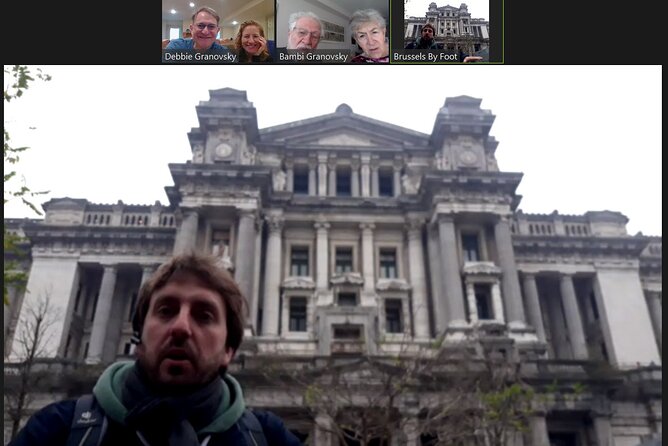
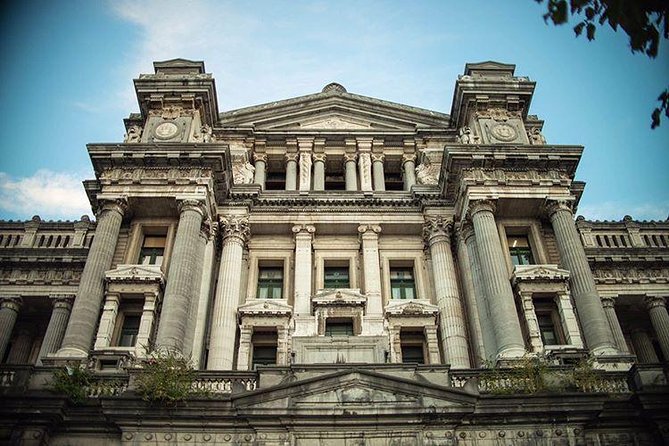
The Palace of Justice is the tour’s longest single stop, at about 15 minutes. It is also likely to be the most memorable for anyone curious about present-day Brussels.
The central story is the building’s renovation. Work began roughly 40 years ago and still has not been completed. Your guide uses this unfinished project to explain a very Belgian scandal involving delays, public money, and the frustrations of maintaining a huge civic building.
This is where the tour connects history with daily politics. Instead of treating the Palace of Justice as a grand structure to admire from a distance, you look at what it represents: government promises, slow public works, and the cost of allowing repairs to continue without a clear end.
I like this stop because it gives you something concrete to watch for after the tour. When you pass the building later, its scaffolding and condition are no longer just part of the view. They become evidence in a larger story about how Brussels manages its institutions.
The guide’s explanation matters here. The facts alone are not hard to find, but the tour frames them within the experience of the Marolles and the surrounding city. That social angle helps explain why a building project can become a neighborhood issue, not merely an engineering problem.
Do not expect a long interior visit. The itinerary lists admission as free, but the experience is a guided outdoor stop rather than a full Palace of Justice tour.
The Marolles elevator and the city view
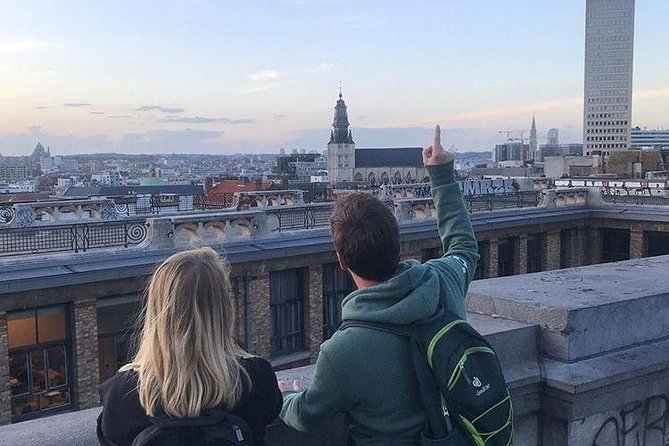
From the Palace of Justice, the walk reaches the Ascenseur des Marolles, or Marolles elevator. You spend about five minutes here, with the focus on the view from the top.
This is the briefest stop, but it provides a useful change of angle. The elevator helps you see Brussels in relation to the district you have been discussing. A city view can turn abstract talk about borders, redevelopment, and social difference into something you can observe in the streets below.
Five minutes is enough for a quick look and a few photographs. It is not enough for a long pause, so keep your camera ready and avoid treating this as a separate viewpoint visit.
The stop also adds a little rhythm to the walk. After the church and the Palace of Justice, which carry heavy historical and political subjects, the elevator offers a lighter visual break before you move into the streets of the Marolles itself.
Other guided walks around Brussels:
- Brussels: City Highlights and Hidden Gems Bike Tour
★ 4.8 · 344 reviews - Brussels Tootbus Discovery Hop On Hop Off Bus and walking tours
★ 3.0 · 336 reviews - Brussels: Walking Tour with Belgian Lunch, Chocolate, & Beer
★ 4.7 · 300 reviews - Brussels Highlights & Hidden Gems Private Tour with a Local Guide
★ 5.0 · 251 reviews
Twenty minutes inside the Marolles
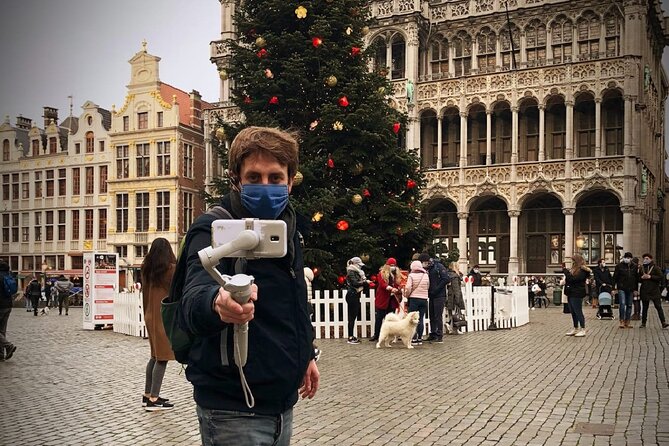
The main neighborhood walk lasts about 20 minutes. This is where the tour’s title takes shape.
The Marolles is described as a quiet, poor neighborhood in the center of Brussels, with small streets and blind alleys. That combination is part of its character. It sits near major landmarks, yet its narrow passages and local identity can make it feel separate from the formal city around it.
Your guide explains the area’s unexpected past and the way its residents have struggled to preserve it. The point is not to romanticize hardship. The value comes from seeing how social conditions, city planning, and local pride interact.
This part of the route also covers the visible and invisible borders within the neighborhood and Brussels. Those borders may not be marked on a street sign. They can show up in reputation, housing, income, language, and the way one part of the city looks at another.
That makes this a good section for asking questions. The guides have been described as willing to explain the Marolles from a local perspective, and the experience is designed around discussion as much as movement. Thomas, Simon, and François are among the guides associated with the experience, so the exact personality and emphasis may vary by departure.
I would pay close attention to the small streets here. The itinerary moves quickly, but the physical setting gives weight to the stories. A blind alley is not just an old urban feature when you are hearing how people lived, moved, and organized themselves in a tightly packed quarter.
This is also the part that may appeal most to residents of Brussels. You can know the city for years and still lack a clear explanation of how the Marolles fits into its wider social history. The walk supplies that missing frame.
Finishing at Place du Jeu de Balle
The final stop is Place du Jeu de Balle, reached after about 10 minutes of discussion about the daily flea market and the effort to conserve the square.
The market gives the tour a practical ending. You are no longer looking at a closed church or a monumental building. You are in a public place that is still used every day, and the guide explains why keeping it matters to the neighborhood.
The square is also a good place to end because you can continue the experience without another scheduled activity. The tour finishes at Pl. du Jeu de Balle 64, in the middle of the square, with bars and restaurants nearby.
If the market is operating during your visit, allow extra time afterward. The tour itself is about two hours, but the square rewards a slower look once the guide has finished. You can browse, eat, or have a drink while the stories are still fresh.
There is an important distinction here. The tour explains the market and its role in the Marolles, but it is not described as a shopping excursion. Come for the history first, then treat browsing as an added pleasure.
What the guide style adds
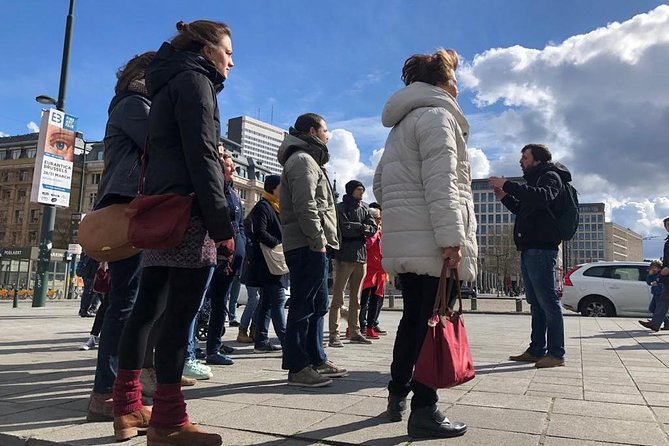
The strongest feature of this experience is the guide’s storytelling. The walk depends on connections between places, and those connections need to be explained clearly.
The tone is not a dry chronology. Expect historical information mixed with anecdotes, local attitudes, and discussion of how it feels to identify with the Marolles. The best moments are likely to come when a guide explains why an ordinary street or building matters to the people around it.
The guide names associated with this tour include François, Simon, and Thomas. Thomas is especially connected with tours that explain the neighborhood’s diversity and its visible and invisible boundaries, while Simon is associated with the social-history focus. François has led groups through the Sablon and Marolles and is noted for a generous storytelling style.
Because several guides lead the experience, you should expect a consistent subject rather than an identical performance. One guide may lean toward political stories, another toward neighborhood life or historical anecdotes. That variation is normal for a walking tour and can keep the format from feeling rehearsed.
The group maximum is 25 people. That is not an intimate private walk, but it is small enough for questions to be practical if the group stays together. If you want one-on-one attention at every stop, this is not the right format. If you want a public walk with room for discussion, the size is reasonable.
Price, tipping, and what you receive
At $3.62 per person, this is unusually inexpensive for a two-hour guided walk in central Brussels. The value is strongest if you care about interpretation rather than paid entry. All listed stops have free admission, so your money goes toward the guide’s time and the structure of the experience.
A €10 gratuity per person is not included. That changes the real cost, especially for a couple or family, but the total remains modest compared with many city walking tours. The gratuity is listed as an additional expense, so plan for it rather than treating the advertised price as the full outlay.
There are no costly museum tickets hidden in the route. You are paying for access to a local explanation of the streets, buildings, and public spaces. For me, that is a good use of a small budget, provided you want a social-history walk.
The tour is offered in English and uses a mobile ticket. Confirmation arrives at booking. It is near public transportation, though the supplied details do not specify particular lines or stops, so check your route to Rue de la Chapelle before setting out.
Who should book this Marolles walk
I would recommend it to you if you enjoy:
- Local social history rather than only famous sights
- Stories about housing, class, public works, and neighborhood identity
- Seeing how a central district can feel separate from the official city
- Guided walks with time for questions
- Returning visitors who already know the Grand Place and want a different Brussels
- Brussels residents who want a clearer understanding of the Marolles
Families can participate, since most people can join and service animals are allowed. Still, the subject is serious and the tour relies on listening, so very young children may not get much from the historical discussion.
The walk also suits visitors who prefer a manageable two-hour activity. You cover several sites without spending half a day indoors. Wear comfortable shoes, since the route moves through streets and public areas, and allow time at the finish if you want to enjoy Place du Jeu de Balle.
I would skip it if your main goal is formal architecture, museum interiors, or a long stop at each monument. The Palace of Justice is a key subject, but this is not a courthouse tour. The church and elevator are also short stops within a broader story.
Booking timing and cancellation
The experience is commonly booked about 25 days ahead, so reserving early makes sense if your Brussels dates are fixed. Confirmation is provided at booking, and the tour requires a minimum number of participants.
You can cancel for a full refund up to 24 hours before the start time. Cancellations or changes made less than 24 hours ahead are not refunded or accepted. If the operator cancels because the minimum number is not reached, you are offered another date or experience, or a full refund.
Should you book Bruxelles, 1000 Ans de Luttes?
Book this tour if you want Brussels explained from street level, with the Marolles as the main character. The Palace of Justice story, the neighborhood’s long fight to preserve its identity, and the finish at Place du Jeu de Balle give the walk a clear shape and plenty to think about.
The price is hard to argue with, especially if you add the tour to a wider Brussels stay. Just keep your expectations straight: this is a compact, English-language history walk with free outdoor stops, not a grand sightseeing package.
For a first visit, it gives you a side of Brussels that many standard routes miss. For a resident, it may change how you read a familiar quarter. I would book it for the stories, the local context, and the chance to see why the Marolles remains such an important part of the city.
FAQ
How long does the tour last?
The tour lasts approximately two hours.
What language is the tour offered in?
The tour is offered in English.
Where does the tour start?
It starts at Rue de la Chapelle 21, 1000 Bruxelles, Belgium, at Église Notre-Dame de la Chapelle.
Where does the tour end?
It ends at Pl. du Jeu de Balle 64, 1000 Bruxelles, Belgium, in the middle of the square.
What places are included?
The route includes Église Notre-Dame de la Chapelle, the Palace of Justice, the Marolles elevator, the Marolles neighborhood, and Place du Jeu de Balle.
Is admission included?
The listed stops have free admission, and an entrance fee is included in the booking information.
Is gratuity included?
No. A gratuity of €10 per person is listed as not included.
How many people can join the tour?
The maximum group size is 25 people.
Can I cancel the booking?
Yes. You can cancel up to 24 hours before the start time for a full refund. Cancellations or changes made less than 24 hours before the start time are not accepted or refunded.
Just added in Brussels
- Standard vehicle from Brussels airport to city of Antwerp★ 5.0 · 4 reviews
- Luxury vehicle from Brussels airport to the city of Brussels★ 4.0 · 5 reviews
- Transfer Brussels Airport (BRU) –> City Center 7 PAX (ONE WAY)★ 5.0 · 7 reviews
- PRIVATE MPV TRANSFER FROM/TO BRUSSELS AIRPORT (Max 6 pax) ONE-WAY★ 5.0 · 4 reviews
- Luxury Minivan from Brussels airport to the city of Brussels★ 4.0 · 7 reviews
- Transfer Brussels Airport –> Brussels MB V Class 7 PAX (ONE WAY)★ 5.0 · 4 reviews
- Transfer Brussels Airport –> City MB E Class 1-3 PAX (ONE WAY)★ 5.0 · 6 reviews
- Brussels: City Walk with Audioguide in 7 Languages on your Phone★ 3.5 · 4 reviews
Walking Tours, compared.

Small Group Boat Cruise and Guided Walking Tour
Read our review →
Walking Tour, Canal Boat Trip w/Beer Tasting Option
Read our review →
Historical Walking Tour with Chocolate & Waffle Tasting
Read our review →
Browse the lists this tour appears in