
Reviewed · DAY TRIPS FROM BRUSSELS
Excursion to Bruges and Ghent by bus from Brussels
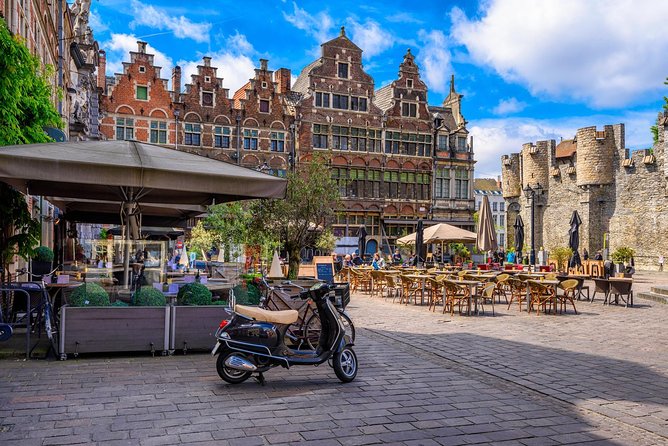
Bruges and Ghent pack much of Belgium’s medieval charm into one long day. You’ll see Bruges’ canals, Market Square, Basilica of the Holy Blood, and Lake of Love, then continue to Ghent for Saint Bavo’s Cathedral, the Castle of the Counts of Flanders, and the Lys River quays. The Spanish-speaking guide gives the buildings a story instead of leaving you to decode them on your own.
I like the round-trip coach from central Brussels, especially for a first visit when figuring out Belgian rail connections may cost precious time. I also like the contrast between the two cities: Bruges feels intimate and carefully preserved, while Ghent feels larger, more urban, and more theatrical. The tradeoff is simple: this is a lot of ground in 10 hours 30 minutes, so both guided walks and free time can feel rushed.
Key points to know before booking
- Two medieval cities in one day: You visit Bruges and Ghent without arranging separate transport.
- Spanish guidance throughout: The guide explains architecture, legends, food, and local history in Spanish.
- Bruges gets the longer visual treatment: Expect canals, Begijnhof, Burg Square, Market Square, and the famous Rozenhoedkaai.
- Ghent includes major landmarks: Saint Bavo’s Cathedral, the Belfry, Korenmarkt, Graslei, Korenlei, and the Meat House are all covered.
- Free time is limited: You get roughly 1.5 hours in each city, depending on traffic and the group’s pace.
- Expect a large group: The coach can carry up to 45 people, and radio headsets may be required in Bruges.
One coach, two very different Belgian cities
The excursion begins at 8:30 a.m. at Carrefour de l’Europe, beside Brussels Central Station. That location is practical if you are staying near the city center or arriving by train, but there is no hotel pickup. You need to reach the meeting point on your own and be ready for a full day.
The coach is air-conditioned and takes you first toward Bruges under the usual plan. The complete outing lasts about 10 hours 30 minutes. That includes the road time between Brussels, Bruges, and Ghent, two guided walks, and free periods in both cities.
The group may be as large as 45 people. That matters more here than on a simple bus transfer because you will be walking through narrow lanes, busy squares, and canal-side paths. Stay close to the guide, listen carefully for meeting instructions, and take a quick photo of the bus location if you like. A few low-rated experiences were tied to unclear return instructions, so do not treat the meeting time as casual advice.
Other days out of Brussels:
- From Brussels: Guided Day Trip to Bruges and Ghent
★ 4.6 · 8,353 reviews - From Brussels: Bruges & Ghent Day Tour – 2 Fairytale Cities
★ 4.7 · 8,242 reviews - Bruges and Ghent – Belgium’s Fairytale Cities – from Brussels
★ 4.0 · 4,809 reviews
Arriving in Bruges by way of Minnewater Lake
The bus drops you at Bargeplein, also called Katelijnparking. You have a short bathroom break before the walking portion begins. From there, the route starts at Minnewater Lake, the Lake of Love, where the guide introduces Bruges and explains the romantic legend tied to the water.
This is a good opening stop because it gives you a quiet first look at the city before the tour enters the tighter medieval center. The stop itself is only about five minutes, so it is for orientation and photographs, not a long lakeside pause.
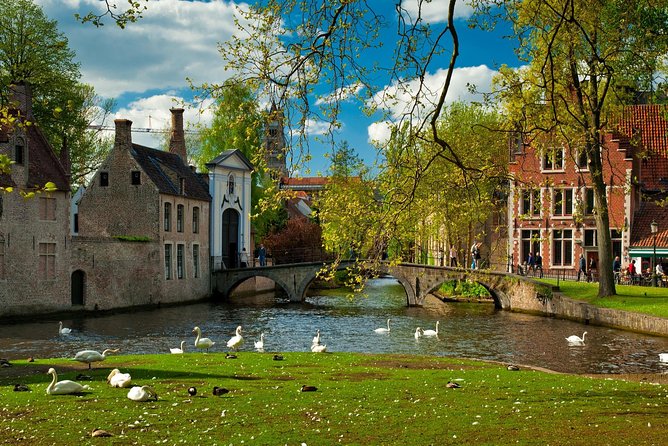
Next comes the Begijnhof, founded in 1245. This former beguinage tells the story of religious women who lived in their own community. The stop lasts about 10 minutes, enough to hear the explanation and take in the calm white buildings and enclosed setting.
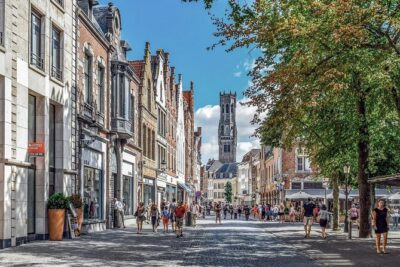
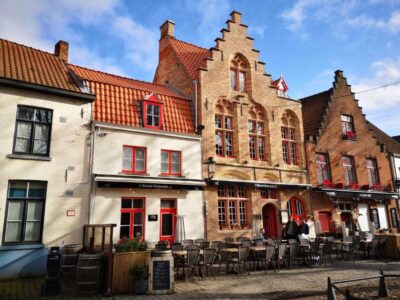
The tour then threads through Stoofstraat, where the guide points out original medieval houses. At Walplein, you hear about Bruges beer. These are short stops, but they help you read the city rather than simply photograph it. Look up at the building fronts and rooflines. The point is to understand how much of Bruges’ appeal comes from ordinary houses and lanes, not only from famous monuments.
Bruges canals, bridges, and old civic power
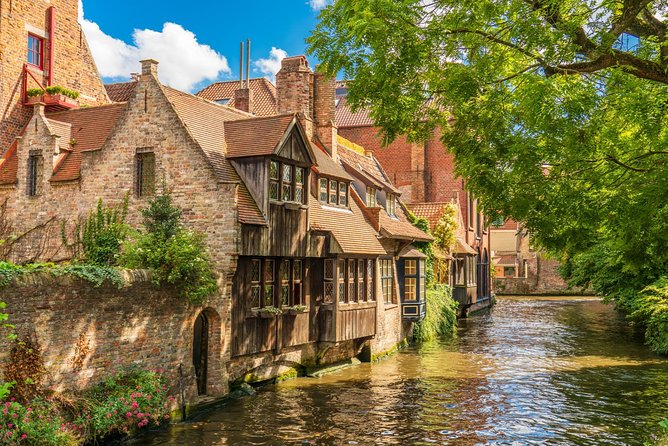
At St. Bonifacius Bridge, the guide tells the local legend connected with one of the city’s prettiest spots. You get time for photographs, and you should use it. Small bridges and canal views are where Bruges feels most like the picture people carry home from Belgium.
The route continues past the old Saint John’s Hospital. Here the guide explains how medieval health care worked. It is a useful stop because the building is not just an attractive stone facade. It represents the practical side of medieval city life, when hospitals served both medical and charitable purposes.
Across from the hospital is the Church of Our Lady. The guide explains the Michelangelo sculpture of the Virgin and Child inside, including why the white marble work is important. The church visit is brief, and this portion is mainly an introduction rather than a long art lecture.
At the Gruuthusemuseum, you hear about the powerful Gruuthuse family. The stop helps explain how wealth shaped Bruges, from grand homes to influence in city affairs. You should not expect extended museum time as part of the guided walk. The value here is the outside context and the connection between architecture and social power.
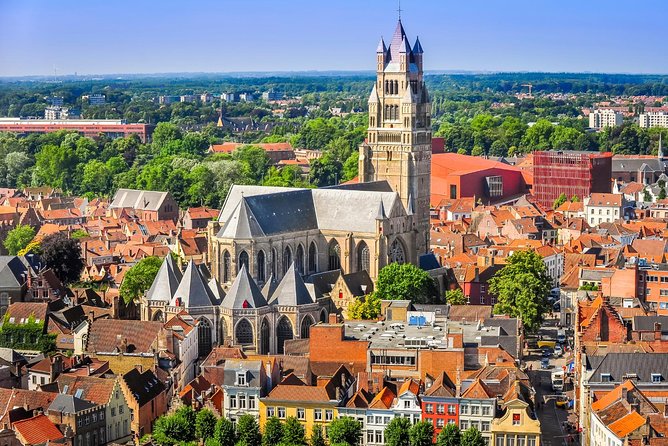
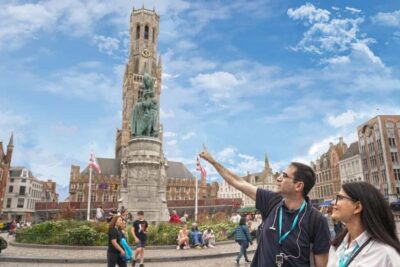
Burg Square is one of the tour’s strongest stops. The Gothic Town Hall, former courthouse, and Basilica of the Holy Blood crowd around the square, giving you several centuries of architecture in one view. The guide spends about 10 minutes here, pointing out the buildings and their roles.
The Basilica of the Holy Blood is especially notable for its ornate facade and religious importance. If you want to enter or spend more time inside, ask the guide about the available free period. The schedule is tight, and the guided stop does not allow much lingering.
Rozenhoedkaai and the chocolate lesson
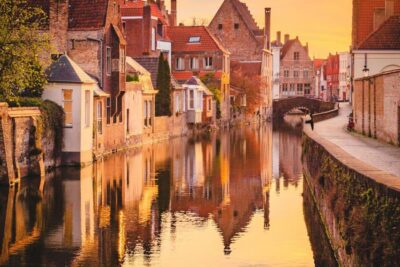
Rozenhoedkaai, often called the Quay of the Rosary, is the most photographed point on the Bruges route. Canal water, old facades, and the bridge make this a natural place for pictures. Your guide explains the story behind the quay, then gives you a short window for photographs.
The route moves on to Huidenvettersplein, the Tanners Square. Here you learn how tanners worked in medieval Bruges. This stop adds a trade story to the tour, showing that the city was built on work and commerce, not only on pretty streets.
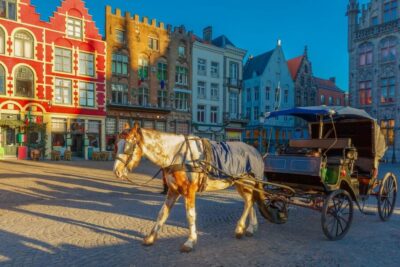
The walking tour finishes at Grote Markt, or Market Square. The guide explains the surrounding buildings and gives practical advice on Belgian chocolate, places to eat, and shops selling traditional treats. That advice can save you from buying the first box you see in a heavily visited square.
There is also a short stop at Chocolalino, described as a certified artisan chocolate shop. You get the chance to taste handmade chocolate, and the guide explains how to tell artisan chocolate from industrial products. This is a useful distinction in Bruges, where attractive packaging does not always tell you much about the contents.
After the guided walk and chocolate stop, you have roughly 1.5 hours of free time, though the exact amount depends on traffic and the group’s pace. That is enough for a quick meal, another look at Market Square, a canal-side stroll, or a shop visit. It is not enough to see every museum, take a canal cruise, and enjoy a leisurely lunch.
If Bruges is your main reason for booking, use the free period with discipline. Choose one priority before you arrive. A short canal walk or a focused visit to one church will work better than trying to cover the whole city.
Same city, a different sort of day:
- Brussels: Atomium Entry Ticket with Design Museum Ticket
★ 4.4 · 9,254 reviews - Choco-Story Brussels: Chocolate Museum Entrance with Tasting
★ 4.3 · 4,883 reviews - Brussels: Hop-On Hop-Off Bus Tour
★ 4.0 · 4,016 reviews - Brussels: Entry Ticket to Mini-Europe
★ 4.5 · 2,870 reviews
The transfer to Ghent and a grander city center
You return to Bargeplein to meet the coach and transfer to Ghent. The coach ride is convenient, but the schedule can shift with traffic. One negative experience described a very long road delay, while other accounts praised the coach as clean and comfortable. That inconsistency is worth keeping in mind, especially if you dislike fixed, full-day schedules.
In Ghent, the group walks toward the center and begins near the Town Hall. The guide points out the building’s different architectural styles. Ghent often feels less uniform than Bruges, and the Town Hall is a good example of that layered character.
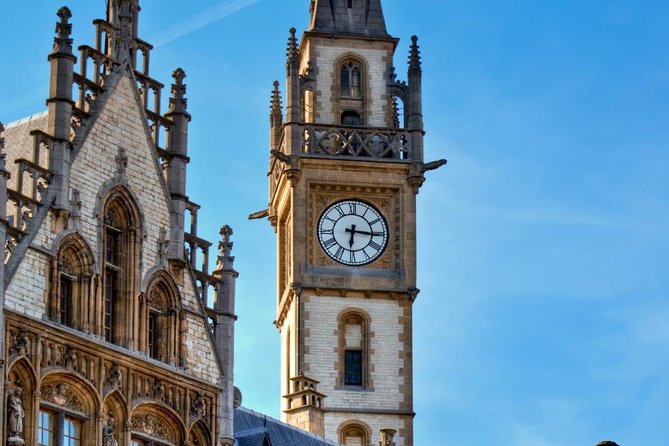
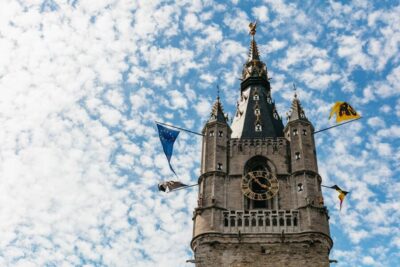
The Belfry of Ghent comes next. The guide explains the tower and the dragon associated with it. You do not climb the tower on this excursion, but the exterior story gives the monument more meaning than a quick photograph would.
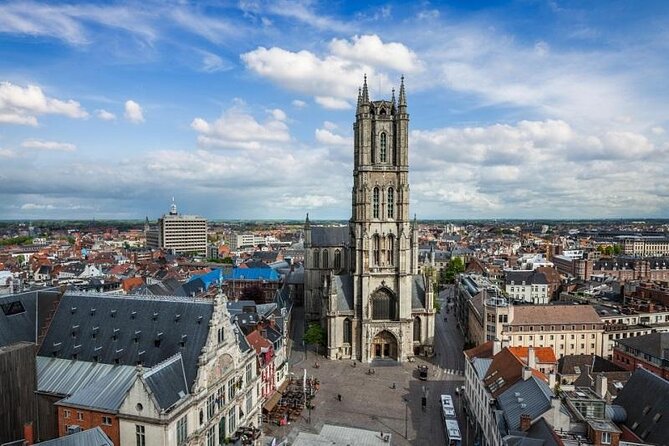
Saint Bavo’s Cathedral receives about 25 minutes, one of the longer stops on the day. You see the outside and interior, and the guide explains the importance of the Van Eyck brothers’ Adoration of the Mystic Lamb. The painting is one of Europe’s best-known works, and the cathedral visit is a major reason to keep Ghent on this itinerary.
The schedule does not promise a long, quiet period for studying every detail of the artwork. If the painting is your personal priority, stay focused when you enter and follow the guide’s timing closely.
Guild houses, river quays, and the Castle of the Counts
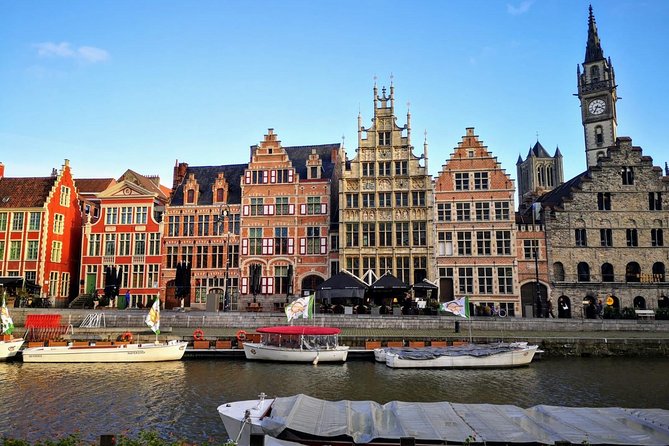
The route passes Saint Nicholas Church, where the guide points out that Belgian churches can host concerts and other events. At the Masons’ Guild Hall, you learn what guild houses were and why their facades matter.
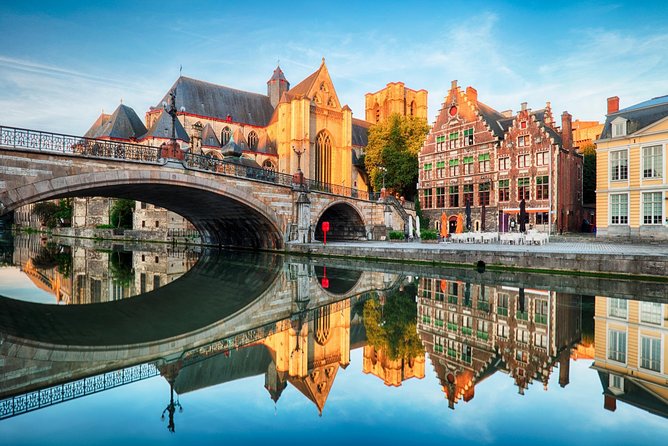
Korenmarkt follows. The guide explains the former post office building and the square’s role in the city center. From there, Saint Michael’s Bridge provides one of the best viewpoints in Ghent. You can photograph several towers and the historic core from here, while the guide explains the story connected with Saint Michael’s Church tower.
The walk continues along Graslei and Korenlei beside the Lys River. These quays are among Ghent’s most attractive public spaces. The guide identifies buildings such as the Grain House and the building now used as the Marriott Hotel. The waterfront is a fine place to slow down for a moment, although the group’s pace may not allow much stopping beyond the scheduled 10 minutes.
The itinerary also includes the Meat House, a 15th-century covered market. At the nearby Kleine Vismarkt, a traditional street seller introduces cuberdons, a famous Ghent sweet. The tasting stop is only a few minutes, but it gives you a local food detail to look for during free time.
The guided portion ends at Sint-Veerleplein. From here, you hear about the square and its surrounding buildings, plus suggestions for food and souvenirs. The Castle of the Counts of Flanders is one of the headline Ghent sights, and the route includes it as part of the historic center visit. Check with the guide about exactly how much time is available at the castle, since the overall route can change with traffic and the group’s pace.
Ghent then gives you approximately 1.5 hours of free time. Some people prefer Ghent to Bruges because it feels less like a preserved postcard and more like a working city. You can use your time for a closer look at the castle area, another walk by the Lys, a snack, or a return to a favorite building from the guided route.
What the price delivers at $54.45
At $54.45 per person, this is a reasonable price for round-trip transport, a full-day schedule, and guided walks in two major Belgian cities. You are paying for convenience as much as for sightseeing. Separate transport to both places, plus two local guides or audio arrangements, would take more planning.
The price does not include food, drinks, hotel pickup, museum extras, or personal purchases. Meals are your responsibility, though the guide offers suggestions. Budget time and money for at least one quick meal, since the free periods are short and a long restaurant lunch could leave you watching the clock.
The best value comes if you want a first look at both cities. The value drops if you want long museum visits, unhurried meals, or detailed photography time. Independent rail travel would give you more control, while this tour removes much of the transport work.
Guide quality, group pace, and practical details
The strongest pattern in the feedback is praise for the Spanish-speaking guides. Guiomara was described as active and attentive, while Eduardo was praised for being friendly, practical, and generous with historical information. Irene, Unai, Carlos, Ana, and Paula also received warm comments for clear explanations and personal help.
That matters because the tour covers a lot of ground quickly. A good guide helps you understand which details deserve attention and keeps a large group moving. The overall rating is 4.7 from 221 ratings, with 92 percent recommending the experience, so the guide component is a genuine strength.
There are also real drawbacks. Some people found the tour too brief, especially in Bruges. One account preferred Ghent and felt it offered more breathing room, while another wanted more time in Bruges. The order can also change. Bruges is generally first, but the operator may visit Ghent first, and one complaint said this left too little time in Bruges.
Bruges may require radio guides under local regulations. You can bring your own wired headphones with a 3.5 mm jack, but wireless headphones are not accepted. If you do not have suitable headphones, disposable ones cost €1. Children under two need an appropriate safety seat on the bus, supplied by the family.
The tour requires good weather and a minimum number of participants. If the operator cancels for either reason, you can receive another date or a full refund. You can cancel for a full refund up to 24 hours before the start time, but changes or cancellations inside that window are not accepted.
Should you book this Bruges and Ghent day trip?
Book it if you have limited time in Brussels and want an efficient first look at Belgium’s two most famous medieval centers. It suits you especially well if Spanish is your preferred tour language, you value clear historical explanation, and you would rather ride a coach than organize multiple train journeys.
Skip it if Bruges or Ghent deserves a full day on its own. The schedule is long, walking-heavy, and fixed. You will see the major sights, but you will not have much time to wander without watching the clock.
For most first-time visitors, the tour earns its place through convenience, strong guide support, and the contrast between Bruges and Ghent. Go in with realistic expectations: this is a well-packed introduction, not a slow study of either city.
FAQ
Where does the tour start and finish?
The tour starts at Carrefour de l’Europe, Carr de l’Europe, 1000 Brussels, at 8:30 a.m. It finishes back at the same meeting point.
Is hotel pickup included?
No. Hotel pickup and return are not included. You need to reach the Brussels meeting point independently.
What language is the tour conducted in?
The professional guide provides the tour in Spanish.
How much free time do I get in Bruges and Ghent?
You receive approximately 1.5 hours of free time in each city, though the exact amount can change with traffic and the pace of the group.
Are food and drinks included?
No. Food and drinks are not included. The guide can recommend places to eat in both cities.
Can I bring my own headphones for the radio guide?
Yes. Your headphones must have a 3.5 mm jack and cannot be wireless. If you do not have suitable headphones, disposable headphones are available for €1.
Just added in Brussels
- Standard vehicle from Brussels airport to city of Antwerp★ 5.0 · 4 reviews
- Luxury vehicle from Brussels airport to the city of Brussels★ 4.0 · 5 reviews
- Transfer Brussels Airport (BRU) –> City Center 7 PAX (ONE WAY)★ 5.0 · 7 reviews
- PRIVATE MPV TRANSFER FROM/TO BRUSSELS AIRPORT (Max 6 pax) ONE-WAY★ 5.0 · 4 reviews
- Luxury Minivan from Brussels airport to the city of Brussels★ 4.0 · 7 reviews
- Transfer Brussels Airport –> Brussels MB V Class 7 PAX (ONE WAY)★ 5.0 · 4 reviews
- Transfer Brussels Airport –> City MB E Class 1-3 PAX (ONE WAY)★ 5.0 · 6 reviews
- Brussels: City Walk with Audioguide in 7 Languages on your Phone★ 3.5 · 4 reviews
Day Trips from Brussels, compared.
Bruges and Ghent – Belgium’s Fairytale Cities – from Brussels
Read our review →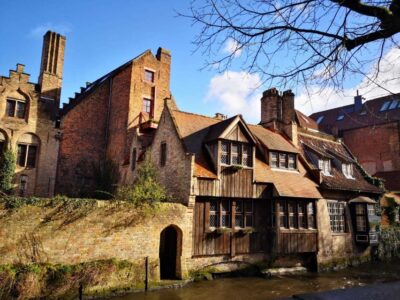
From Paris: Day Trip to Bruges with Optional Seasonal Cruise
Read our review →Browse the lists this tour appears in