
Reviewed · TOURS IN BRUGES
Ticket Expo Body Worlds in Bruges, Belgium
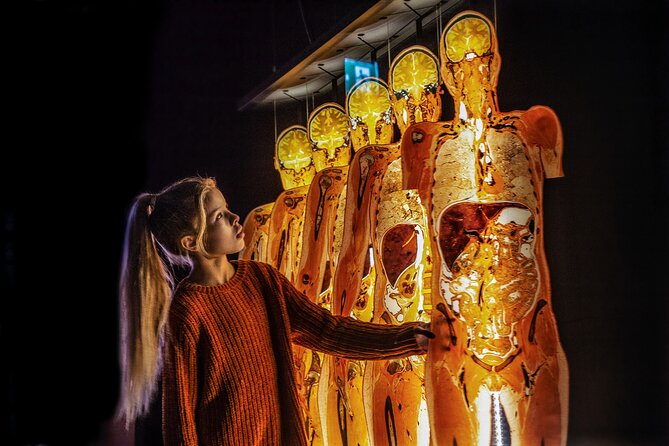
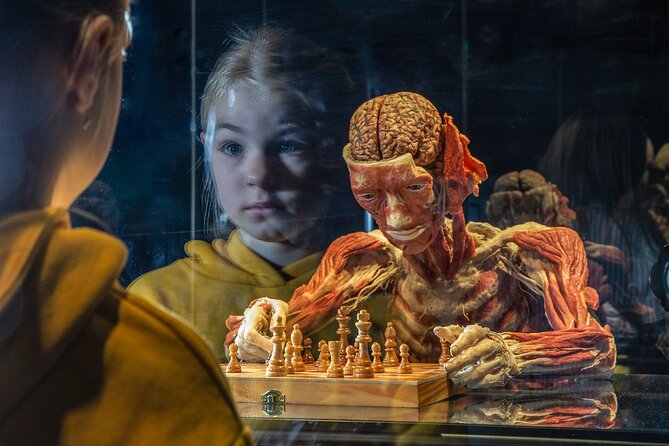
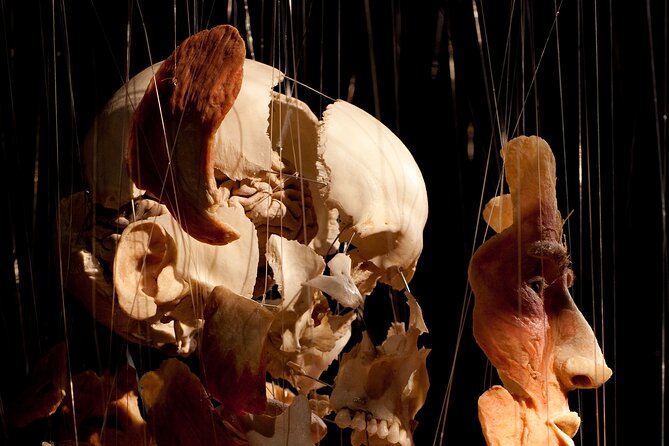
The most striking part of BODY WORLDS VITAL is its use of real human specimens arranged in lifelike poses. You see the body as a working machine, with muscles, organs, blood vessels, and bones shown together rather than hidden in a textbook diagram. The display can be confronting, but it is also unusually clear.
I like the wide range of specimens, from whole-body plastinates to delicate organ slices and blood-vessel forms. I also like the anatomical mirror, an oversized projection that lets you watch your own movements alongside an image of your internal structure.
The main drawback is the subject matter. This is not a light museum stop, and some displays may feel intense, especially the developmental material and the examples of illness. At about $81, the visit makes the most sense if anatomy, medicine, or science is a real interest for you.
Key points to know before you go
- More than 200 real specimens: See whole-body plastinates, organs, translucent slices, blood-vessel configurations, and stages of human development.
- Life-like body positions: Specimens are arranged in scenes such as sports and intimate human activity to show how anatomy works in motion.
- Interactive anatomical mirror: Watch your internal reflection on a large projection and see how body movement relates to the organs inside.
- Former city hospital setting: The exhibition occupies the 19th-century halls of Site Oud Sint-Jan, the Old St. John hospital site.
- Easy central location: The venue is about 10 minutes on foot from Bruges railway station and Market Square.
- Allow 1 to 2 hours: The mobile ticket is practical for a self-guided visit, with no guide name or guided-tour schedule provided.
BODY WORLDS inside Bruges’ Old St. John site
BODY WORLDS VITAL is housed at Site Oud Sint-Jan, a former city hospital in the center of Bruges. The setting matters. You are not walking into a modern science center on the edge of town. You are entering old hospital halls, then looking at the body through the lens of anatomy, health, and disease.
The exhibition presents more than 200 real human specimens preserved through plastination. This process allows the body, organs, and vessels to be displayed without the usual decay of biological tissue. The result is a collection that looks precise and physical rather than like a plastic model.
I find that distinction useful. A drawing can show you where the heart sits, but a whole-body specimen can show the relationship between the heart, lungs, ribs, spine, and major blood vessels at once. You can see how the parts fit together in three dimensions.
The subject is handled with a stated focus on respect for people who donated their bodies to science. You will also find a film explaining how bodies are prepared for display. That context is important because it gives the exhibition a medical and educational purpose instead of treating the specimens as simple curiosities.
Other tickets worth pre-booking in Bruges:
- Bruges: Frietmuseum Entry Ticket
★ 4.2 · 652 reviews - Bruges: Historium Bruges Story and VR Ticket
★ 4.5 · 595 reviews - Historium Story + VR Ticket
★ 4.5 · 369 reviews
The first look: whole bodies in everyday motion
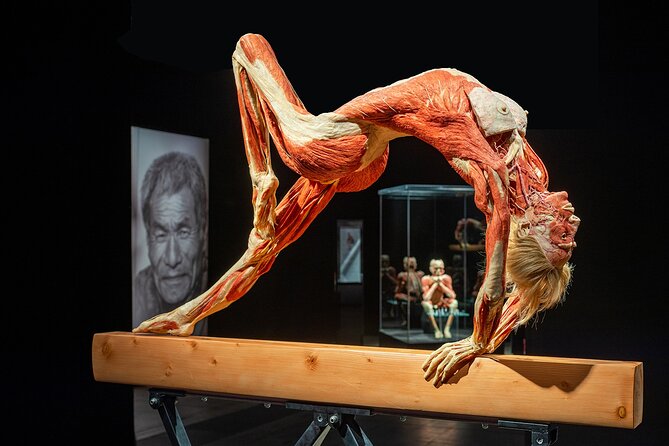
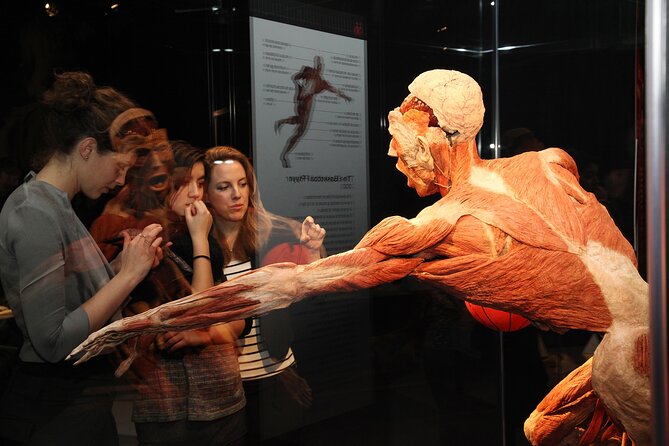
The whole-body plastinates form the exhibition’s most memorable section. They are placed in life-like positions, including sporting movements and intimate human activity. The point is not shock for its own sake. These arrangements show how muscles, joints, bones, and organs work together when the body moves.
That approach helps you connect anatomy to ordinary life. A skeleton diagram tells you where the bones are. A posed plastinate can show how the shoulder, spine, hips, and legs relate during motion. You may also see the position of internal organs in relation to the body’s outer shape.
The displays can feel personal because the figures retain recognizable human proportions. If you are comfortable with medical exhibits, this makes the science easier to understand. If you are sensitive to human remains, the lifelike poses may be the hardest part of the visit.
Take your time here rather than rushing from one figure to the next. Look at the labels and compare the outer pose with the inner arrangement. The exhibition works best when you treat each specimen as an anatomy lesson, not just as an unusual object.
Organs, vessels, and the body in sections
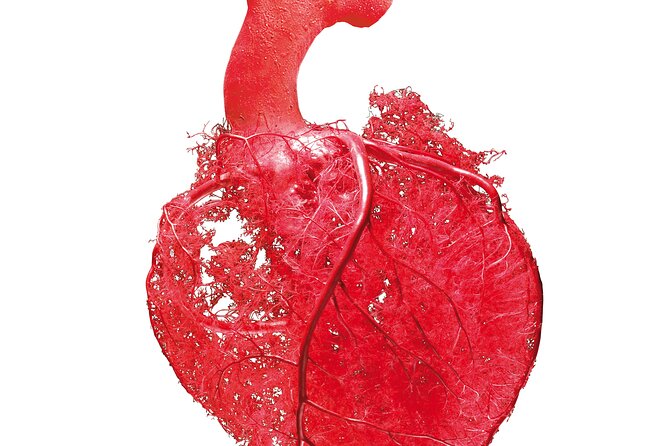
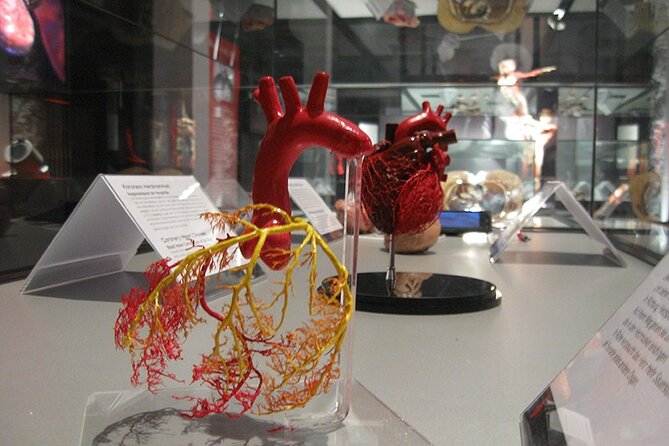
The collection goes beyond full-body figures. You will see individual organs, organ configurations, translucent slices, and blood-vessel displays. These smaller pieces help explain details that are difficult to see in a complete body.
The organ displays can make the visit more useful for anyone who wants a basic understanding of how the body is arranged. You can compare a single organ with its position in a whole-body specimen, then see how it relates to nearby structures.
The translucent slices offer another way to view the body. Instead of looking at one surface, you see anatomy in thin sections. This can help you understand how structures change from one level to the next, much like turning pages in a three-dimensional atlas.
The blood-vessel configurations are especially striking because they show the body’s circulation as a branching network. You can see the scale and complexity of the system more clearly than you can in most diagrams. The display also gives you a better sense of why damage to one part of the circulatory system can affect the rest of the body.
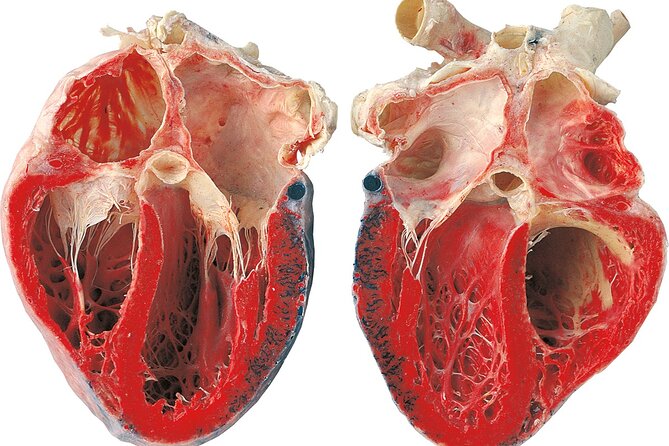
The exhibition also includes examples of the body in health and distress. That contrast gives the visit more depth. You are not only seeing what a healthy body contains, but also how illness and physical problems can alter organs and tissues.
Development, disease, and a serious tone
BODY WORLDS VITAL includes a fetus and stages of development. This section can be one of the most educational parts of the visit, but it may also be emotionally difficult. The material asks you to look at human growth in a very direct way.
You may find the developmental displays useful if you are interested in biology or prenatal growth. They show change over time rather than presenting the body as a finished object. At the same time, the subject calls for a slower and more thoughtful pace.
The examples of disease serve a similar purpose. You can see the physical effects of conditions that are often discussed only in abstract terms. Instead of hearing that an organ has been damaged, you can see how its structure has changed.
This is where the exhibition moves beyond spectacle. It asks you to consider both the body’s strength and its limits. The message is not that people should fear illness. It is that the body’s systems are connected, and that health depends on many parts working together.
Same city, a different sort of day:
- Bruges: Small Group Boat Cruise and Guided Walking Tour
★ 4.8 · 4,102 reviews - Bruges: Walking Tour, Canal Boat Trip w/Beer Tasting Option
★ 4.4 · 2,759 reviews - Historical Walking Tour: Legends of Bruges
★ 5.0 · 2,541 reviews - Bruges: Choco-Story Chocolate Museum Guided Tour w/Tastings
★ 4.2 · 1,379 reviews
The anatomical mirror gives you something to do
The interactive anatomical mirror is the most hands-on part of the visit. It uses a large projection to show your internal reflection while you move. You can watch how your body is configured in relation to its organs and see how movement changes the picture.
I like this feature because it shifts the focus from preserved specimens to your own body. After looking at fixed examples, you get a chance to think about your own posture, motion, and internal arrangement. It offers a simple way to connect the exhibition’s science with your everyday experience.
It is also helpful for visitors who prefer an interactive stop rather than a purely visual display. You can explore how your body moves instead of only reading labels. The feature does not replace the specimens, but it breaks up the sequence and gives the visit a more active rhythm.
The exhibition is not designed as a guided tour, and no guide names or scheduled guide-led format are provided. Your experience will therefore depend on how much time you spend reading, comparing, and using the interactive elements.
How long to allow and how to plan your visit
The stated visit time is about 1 to 2 hours. That is enough for a focused visit, but the exact length depends on how closely you study the specimens and how long you use the anatomical mirror.
I would allow the full two hours if anatomy is a strong interest or if you are visiting with someone who likes to read every explanation. One hour can work if you want a clear overview before continuing through Bruges.
The central location makes BODY WORLDS easy to add to a day of sightseeing. The venue is about a 10-minute walk from the railway station and about 10 minutes from Market Square. You can visit before exploring the historic center, or use it as a break from churches, canals, and old streets.
The mobile ticket is convenient because you do not need to carry a printed voucher. Admission is included with the booking. The supplied opening schedule lists daily hours from 10:00 a.m. to 6:00 p.m.
There is a date detail worth checking carefully. The exhibition information also refers to a run ending November 5, 2023, while the current schedule provided for booking lists dates from March 5, 2025, to September 3, 2026. Because those dates do not match, confirm the operating date shown at the time you book.
Is the $81 price good value?
At $81, this is not a cheap quick stop. I would not recommend it to everyone who simply wants another attraction ticket in Bruges. The price needs to be judged against your interest in medical science and the amount of time you plan to spend inside.
The value is stronger if you want a serious anatomy exhibition with real specimens, interactive elements, and a central location. You are getting more than one display type: whole bodies, organs, vessel forms, slices, developmental material, and examples of disease. That range gives the visit substance.
The value is weaker if you dislike medical exhibits or expect a conventional museum with paintings, architecture, or local history. BODY WORLDS is focused almost entirely on the human body. Bruges offers plenty of other sights, so you should choose this only if its subject fits your interests.
The high rating attached to the experience reflects its educational appeal, but I would still treat the price as a personal decision. For a student, health professional, science-minded adult, or curious solo visitor, it may be worthwhile. For a family with young children or anyone uncomfortable with human remains, it may not be the best use of the budget.
Who will enjoy this Bruges exhibition?
I think BODY WORLDS VITAL suits adults and older children who are comfortable with anatomy, medicine, and direct displays of human remains. A solo visitor can move at an easy pace, use the interactive mirror, and spend extra time with the sections that matter most.
It also suits people who learn by seeing rather than by reading. The specimens show relationships that can be hard to picture from a textbook. You can look from the full body to the organs, then connect the parts through the posed figures.
The exhibition can work for families, but I would explain the subject before arriving. The lifelike presentation, fetus display, and disease material are not hidden or softened. Children should be able to handle a serious science exhibit, and the decision should be made by the adults in the group.
Most visitors can participate, and service animals are allowed. The site is near public transportation, which helps if you are building the visit into a day without a car. No special physical restrictions are given in the supplied information, so you should check directly if you need specific access details.
Practical booking and cancellation advice
The experience includes free cancellation if you cancel at least 24 hours before the scheduled start time. A cancellation made within 24 hours is not refunded, and changes inside that period are not accepted.
The cut-off uses local time in Bruges. That matters if you are booking from another country or arranging the visit around a train connection.
Because the attraction is centrally located and takes about 1 to 2 hours, it is easy to pair with other Bruges sights. Still, do not book it too tightly between timed plans. The exhibition may be short for some people and much longer for others, especially if you stop at every explanation and spend time with the interactive display.
Should you book BODY WORLDS VITAL?
Book it if you want a clear, direct look at human anatomy and you are comfortable seeing real preserved human specimens. The combination of lifelike full-body displays, organ and vessel studies, developmental material, and the anatomical mirror gives you plenty to examine in one visit.
Skip it if you want a traditional Bruges attraction or if the subject of human remains feels unpleasant. At $81, it is too expensive to choose simply because you have spare time.
For the right visitor, this is a useful change of pace from Bruges’ medieval streets. It shows how the body works in motion, how illness affects it, and how much structure exists beneath ordinary movement. Confirm the current exhibition dates, allow up to two hours, and book when you know the subject is a good match for you.
FAQ
Where is BODY WORLDS VITAL located?
The exhibition is at Site Oud Sint-Jan, the former city hospital site in Bruges, Belgium. It is about a 10-minute walk from Bruges railway station and Market Square.
How long does the visit take?
The estimated duration is 1 to 2 hours.
What can I see inside the exhibition?
You can see more than 200 specimens, including whole-body plastinates, individual organs, organ configurations, translucent slices, blood-vessel configurations, and stages of human development.
Is there an interactive feature?
Yes. The exhibition includes an anatomical mirror, which uses an oversized projection to show your internal reflection and how your body moves in relation to its organs.
Is admission included with the ticket?
Yes. Admission to BODY WORLDS VITAL is included.
What are the opening hours?
The supplied schedule lists opening hours every day from 10:00 a.m. to 6:00 p.m., for dates from March 5, 2025, through September 3, 2026. Check the date shown when booking because another piece of exhibition information lists an earlier closing date.
Can I cancel for a refund?
Yes. You can receive a full refund if you cancel at least 24 hours before the experience start time. Cancellations or changes made within 24 hours are not accepted for a refund.
Just added in Bruges
- 2-Hour Private Walking Tour of Bruges★ 5.0 · 13 reviews
- 6 Hour Bruges Shore Excursion from Zeebrugge Cruise Port★ 4.5 · 23 reviews
- Explore the Instaworthy Spots of Bruges with a Local★ 5.0 · 3 reviews
- The Waffles ‘n Coffee Breakfast in Bruges Centre★ 4.5 · 9 reviews
- Australian Battlefields Private Tour in Flanders from Bruges★ 5.0 · 15 reviews
- Discover the secrets of Bruges by playing!★ 4.5 · 7 reviews
- Bruges Walking Tour with Audioguide on Your Smartphone★ 4.5 · 14 reviews
- Discover Bruges with a self-guided Outside Escape city game tour!★ 5.0 · 4 reviews
Tours in Bruges, compared.

Small Group Boat Cruise and Guided Walking Tour
Read our review →
Walking Tour, Canal Boat Trip w/Beer Tasting Option
Read our review →
Choco-Story Chocolate Museum Guided Tour w/Tastings
Read our review →
Great War Flanders Fields Minibus Tour w/ Lunch
Read our review →

Belgian Waffle-Making Workshop with Beer Tasting
Read our review →
Browse the lists this tour appears in