
Reviewed · TOURS IN BRUSSELS
Brussels: Private Tour of the Upper and Lower City
Brussels makes more sense when you see it in two parts. This tour traces the city’s Lower City, with its medieval lanes, famous squares, opera house, and shopping arcades, then climbs into the Upper City, where the cathedral, royal park, museums, and Sablon reveal a more formal side of the capital.
I like the clear historical structure and the private format. You can ask your guide to shape the tour around Art Nouveau, Belgian beer, chocolate, architecture, or a more academic approach. Guides such as Emil and Mr. Boeykens have also shown they can keep the mood friendly when the weather turns cold.
The main drawback is time. Three hours gives you a strong orientation, but not enough time to properly visit every museum or linger at each square. Museum tickets, food, drinks, and transport are extra.
Key points about this Brussels tour
- Two distinct city levels: Follow Brussels from the Lower City’s old commercial center up to the Upper City’s royal and cultural quarter.
- Grand Place anchors both halves: Begin at Brussels’ grand central square, then return there before heading uphill.
- Private and adjustable: Ask for an entertaining, academic, or professional style, with hotel pickup available in Brussels.
- A useful mix of sights: See Manneken Pis, Saint Catherine Square, the opera house, the cathedral, royal park, museums, and Sablon.
- Good language choice: Guides are available in Spanish, Dutch, English, French, German, Italian, Russian, and Portuguese.
- Best for orientation: This is a sightseeing and history walk first, not a museum-entry tour or food tasting.
Starting at Grand Place, Brussels’ grand introduction
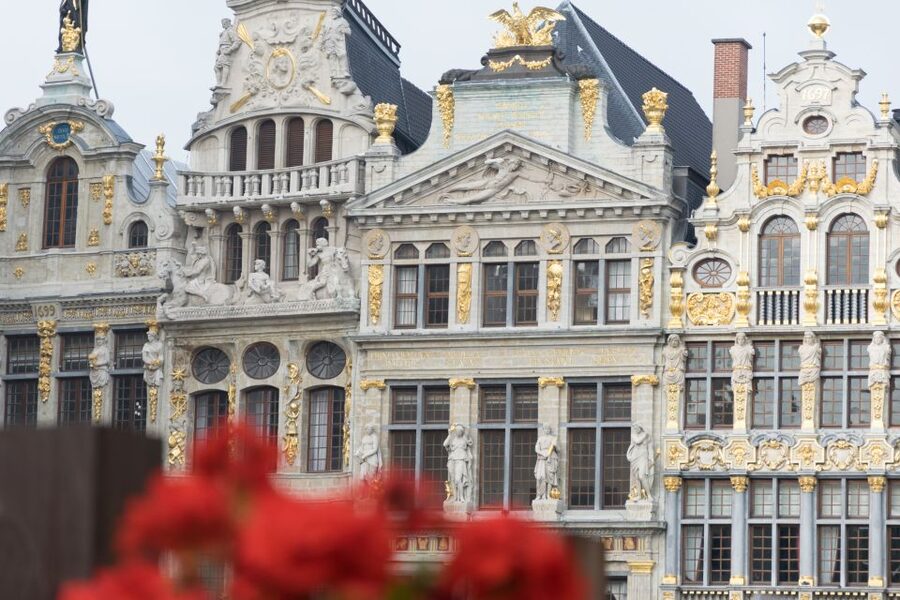
The tour begins at Grand Place, the natural starting point for Brussels. This broad square brings together ornate historic buildings and the city’s central civic life. It is also the perfect place to begin a conversation about how Brussels developed from a small settlement into Belgium’s capital.
Because the tour returns to Grand Place for the Upper City portion, you get a useful sense of direction. The square is not just a photo stop. It acts as the hinge between two different sides of Brussels.
Your guide can set the tone to suit your group. If you want a lively introduction, ask for an entertaining style. If you are more interested in urban development, political history, or architecture, request an academic or professional approach. That flexibility matters on a private tour because your guide does not have to aim at an anonymous crowd.
From Grand Place, you walk toward Manneken Pis. The small bronze boy is one of Brussels’ most recognizable symbols, even though its size can surprise first-time visitors. The point here is less about spending a long time at the statue and more about seeing how Brussels mixes major civic monuments with playful local character.
A few more things to do in Brussels worth a look
- Brussels Highlights & Hidden Gems Private Tour with a Local Guide
★ 5.0 · 251 reviews - Brussels: Belgian Beer Tasting and Course at a Private Bar
★ 4.6 · 219 reviews - Brussels PRIVATE TOUR With Locals: Highlights & Hidden Gems
★ 5.0 · 177 reviews
The Lower City, from Saint-Géry to Saint Catherine
The route continues toward Saint-Géry island, once the largest island in the Senne River. This gives your guide a useful opening to explain the city’s early geography and the role of water in Brussels’ development.
You then reach Saint Catherine Square, an attractive part of the Lower City with a different feel from the ceremonial Grand Place. The route continues through De Brouckère and Monnaie squares, bringing you into some of the city’s important public and cultural spaces.
The opera house is one of the major stops in this section. The federal opera house of Belgium introduces the country’s musical life and gives the walk some variety after the earlier medieval and civic landmarks. You will not be taking in a full performance during this tour, but the building helps show how Brussels functions as a national cultural center.
The Lower City segment is particularly useful if you have just arrived in Brussels and want to understand the city’s layout. The route links major points rather than treating them as isolated postcard stops. You see how squares, public buildings, shopping areas, and older quarters fit together.
Saint-Hubert Royal Galleries and Brussels’ polished side
The Lower City portion ends at the Saint-Hubert Royal Galleries, a group of glazed shopping arcades. Their elegant covered passages add a refined note to the walking route and offer a change from open squares and busy streets.
This is also one of the places where the tour’s architectural focus pays off. You can ask your guide to explain the galleries’ design and place them within Brussels’ wider interest in grand public spaces, decorative buildings, and Art Nouveau.
Do not expect a shopping excursion with lots of free time built in. The tour is designed to keep moving through the city, and the galleries are part of the route rather than a dedicated retail stop. If you want to browse carefully, tell your guide at the start so your expectations are clear.
The first section gives you the older, lower part of Brussels. Then the itinerary returns to Grand Place before heading uphill. This repeated starting point may sound slightly unusual, but it keeps the two-part structure easy to follow.
Climbing toward the Upper City cathedral
The Upper City portion starts at Grand Place and climbs toward the Cathedral of St. Michael and St. Gudula. This change in elevation is an important part of the tour’s story. You are moving from the historic commercial center toward the city’s religious, royal, and cultural quarter.
Inside the cathedral, you can admire the stained-glass windows. This is one of the few clearly identified interior moments on the route, so make good use of it. The visit is still part of a walking orientation rather than a long church tour, but the windows give you a chance to pause and look closely.
The cathedral also helps explain the formal character of the Upper City. Its scale and decoration contrast with the compact, playful impression created by Manneken Pis. I like this pairing because it shows two very different faces of Brussels without forcing the city into one neat style.
Since the tour is private, you can ask questions as you go. A guide can point out architectural details, explain the city’s development, or keep the discussion lighter if your group prefers. A German-speaking guide named Emil received especially strong praise for balancing different periods of the city’s development, which is exactly the skill this route needs.
Same city, a different sort of day:
- Brussels: Atomium Entry Ticket with Design Museum Ticket
★ 4.4 · 9,254 reviews - From Brussels: Guided Day Trip to Bruges and Ghent
★ 4.6 · 8,353 reviews - From Brussels: Bruges & Ghent Day Tour – 2 Fairytale Cities
★ 4.7 · 8,242 reviews - Choco-Story Brussels: Chocolate Museum Entrance with Tasting
★ 4.3 · 4,883 reviews
Royal Park and Place des Palais
From the cathedral, the route continues to Place des Palais, near the royal park and palace. This part of Brussels feels more official and spacious than the Lower City. The royal setting adds political context to the tour, showing how the capital’s ceremonial center differs from its older commercial quarters.
The itinerary allows you to pass through the royal park and see the palace area, but it does not include a palace interior visit. That distinction matters if you are expecting a ticketed royal attraction. The focus is on the setting, the architecture, and the role of this quarter in Brussels.
This is also a good place to ask about Belgium’s national institutions and the city’s role as a capital. The tour description leaves room for an informative approach, but exact commentary will depend on your guide and the style you request.
The route’s uphill movement can be a consideration for some groups. The activity is wheelchair accessible, but you should discuss the route and any specific needs with the provider when arranging pickup and timing. A private group gives you more scope to request a suitable pace.
Museums, Magritte, and the Sablon finish
After the royal quarter, you may visit the Musical Instruments Museum or pass by the Magritte Museum and the Palace of Fine Arts before reaching Petit Sablon and Grand Sablon.
The wording here is important. Museum admission is not included, and the three-hour format does not allow a full museum experience alongside the complete walking route. Treat these cultural institutions as optional points of interest unless you arrange a different plan with your guide.
The Musical Instruments Museum gives the tour a chance to move beyond monuments and streets into Belgium’s cultural life. The Magritte Museum offers a route toward Belgian surrealism, while the Palace of Fine Arts adds another major cultural landmark. Seeing these places from outside can help you decide where to return later for a longer visit.
Petit Sablon and Grand Sablon provide a satisfying finish. The Sablon area brings together elegant architecture, public spaces, galleries, antiques, chocolate shops, and a more polished atmosphere. The tour does not include chocolate tastings or drinks, but your guide can place Belgian chocolate and beer within the broader story of Brussels culture.
For a first visit, ending in Sablon is practical. You can continue exploring on your own, stop for food, or use the area as a base for a later museum visit.
What the private format changes
The price is listed at $353 per group of up to 20 people. That can be good value for a family, company, or large group that would otherwise pay separate per-person fees. For only two people, the price is much harder to justify unless you place a high value on a private guide and a tailored route.
The activity is described as a private group, with tours limited to 25 participants for service quality. Since the stated group price covers up to 20 people, ask for clarification if your party is larger than 20. That small check can prevent confusion at booking time.
Hotel pickup is possible from your Brussels hotel, but transport is not included. This likely means the guide can meet you at the hotel, while the tour itself is primarily a walking experience. Confirm the meeting details, especially if your hotel lies outside the central area.
The three-hour length is well suited to a first look at Brussels. You get a connected route through both city sections without giving up an entire day. On the other hand, the schedule is too short for extended museum visits, a long chocolate stop, and relaxed time at every square.
Guide style, language, and pace
The tour is available in English, French, Dutch, Spanish, German, Italian, Russian, and Portuguese. That wide language range is useful for families and mixed-language groups, but confirm your preferred language before booking.
The option to request an entertaining, academic, or professional approach is one of the tour’s best features. A group with children may want shorter explanations and more local stories. Architecture fans may prefer a closer look at Art Nouveau and the city’s public buildings. A business group may want a concise overview of Brussels as a European capital.
A guide named Mr. Boeykens was praised for sharing plenty of information while keeping the group in good spirits despite cold weather. That detail is worth noting because Brussels weather can be damp and unpleasant, especially during a walking tour. Wear comfortable shoes and bring a layer, even if the forecast looks mild.
The overall rating is 4.3 from 33 ratings, which suggests a generally strong experience with some room for variation. As with any private guided walk, the quality depends heavily on the individual guide, your requested focus, and how much time is spent at each stop.
Who should book this Brussels walk?
I would recommend this tour to first-time visitors who want to understand Brussels before choosing where to return. It is also a good fit for families, small companies, and larger private groups that want one guide and one shared route.
It suits people who enjoy architecture, city history, royal settings, museums, Belgian beer, and chocolate as cultural subjects. It is less suitable if your main goal is a guided tasting, a long museum visit, or a relaxed café afternoon.
The itinerary includes many sights, so you should expect a steady pace. If someone in your group walks slowly or needs frequent rests, use the private format to negotiate the timing. The activity is wheelchair accessible, but the route includes movement between the Lower and Upper City, so discuss practical needs in advance.
Should you book it?
Book this tour if you want a clear three-hour introduction to Brussels with a guide who can adjust the tone and language to your group. The Lower City and Upper City structure gives you a useful mental map, and the route includes many of the city’s best-known landmarks without requiring a full day.
The value is strongest for larger groups, since the $353 price is charged by group rather than per person. For a couple, compare the cost with a standard group walk. For museum lovers, plan to return independently because tickets are not included and the tour cannot give every cultural stop much time.
If you want a private overview, hotel meeting option, flexible subject matter, and a broad look at Brussels, this is a sensible choice. Just keep your expectations focused on orientation and context, not tastings or extended interior visits.
FAQ
How long is the Brussels private tour?
The tour lasts three hours.
What areas of Brussels does the tour cover?
It covers both the Lower City and Upper City, including Grand Place, Manneken Pis, Saint-Géry, Saint Catherine Square, De Brouckère, Monnaie, the opera house, the cathedral, the royal quarter, museums or museum exteriors, and the Sablon area.
Is this a private tour?
Yes. It is offered as a private group experience. The stated group price is for up to 20 people, while the service information says groups are limited to 25 participants.
Can the tour start at my hotel?
Pickup is possible from your Brussels hotel. Transport is not included, so confirm the meeting arrangements when booking.
Which languages are available?
Guides are available in Spanish, Dutch, English, French, German, Italian, Russian, and Portuguese.
Are museum tickets included?
No. Museum tickets, meals, drinks, and transport are not included.
Can the itinerary be adjusted?
Yes. The itinerary can be arranged around your group’s preferences, including an entertaining, academic, or professional style.
Just added in Brussels
- Standard vehicle from Brussels airport to city of Antwerp★ 5.0 · 4 reviews
- Luxury vehicle from Brussels airport to the city of Brussels★ 4.0 · 5 reviews
- Transfer Brussels Airport (BRU) –> City Center 7 PAX (ONE WAY)★ 5.0 · 7 reviews
- PRIVATE MPV TRANSFER FROM/TO BRUSSELS AIRPORT (Max 6 pax) ONE-WAY★ 5.0 · 4 reviews
- Luxury Minivan from Brussels airport to the city of Brussels★ 4.0 · 7 reviews
- Transfer Brussels Airport –> Brussels MB V Class 7 PAX (ONE WAY)★ 5.0 · 4 reviews
- Transfer Brussels Airport –> City MB E Class 1-3 PAX (ONE WAY)★ 5.0 · 6 reviews
- Brussels: City Walk with Audioguide in 7 Languages on your Phone★ 3.5 · 4 reviews
Tours in Brussels, compared.
Atomium Entry Ticket with Design Museum Ticket
Read our review →
Choco-Story Brussels: Chocolate Museum Entrance with Tasting
Read our review →
Bruges and Ghent – Belgium’s Fairytale Cities – from Brussels
Read our review →
Hungry Mary’s Famous Beer and Chocolate Tour in Brussels
Read our review →Browse the lists this tour appears in